
The Foreign Investment Email Scam is one of the oldest and most persistent forms of online fraud. Scammers contact victims claiming to be government officials, business leaders, or individuals fleeing political turmoil who urgently need a trustworthy foreign partner to help transfer or invest large sums of money. These messages often appear unexpected, include dramatic personal stories, and promise life changing financial rewards if the recipient agrees to assist with the transfer of supposed investment capital. Although this scam is widely known, variations continue to circulate globally and remain highly effective at deceiving individuals who are unfamiliar with the warning signs.
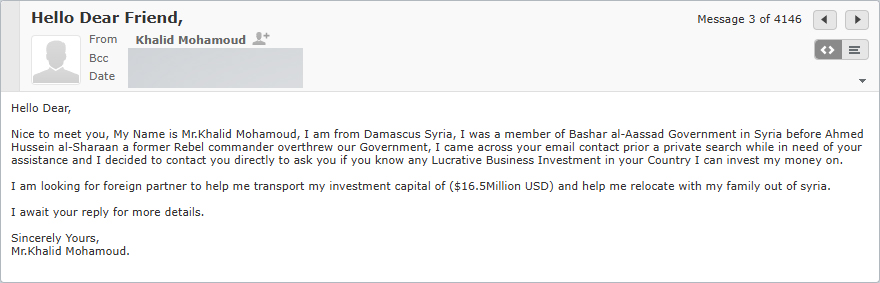
Hello Dear,
Nice to meet you, My Name is Mr.Khalid Mohamoud, I am from Damascus Syria, I was a member of Bashar al-Aassad Government in Syria before Ahmed Hussein al-Sharaan a former Rebel commander overthrew our Government, I came across your email contact prior a private search while in need of your assistance and I decided to contact you directly to ask you if you know any Lucrative Business Investment in your Country I can invest my money on.
I am looking for foreign partner to help me transport my investment capital of ($16.5Million USD) and help me relocate with my family out of syria.
I await your reply for more details.
Sincerely Yours,
Mr.Khalid Mohamoud.
A recent variation involves messages from individuals claiming to be former government officials from Syria, such as the fraudulent message sent by a scammer identifying himself as “Mr. Khalid Mohamoud.” In this version of the foreign investment email scam, the sender claims that his government has been overthrown and that he must relocate his family out of Syria. He states that he possesses more than 16 million USD in investment capital and needs a trustworthy foreign partner to assist with transferring the funds and investing them in a lucrative business opportunity in another country. These claims are entirely false, but they mimic language used in a long running family of scams that have historically originated from political regions in crisis.
Scammers operating foreign investment fraud schemes frequently adopt identities linked to conflict zones, collapsed governments, or unstable regions. This helps them justify why they supposedly cannot move their funds safely or through official channels. They may also reference political revolutions, rebel groups, or humanitarian crises in order to create urgency and appear sympathetic. These messages appeal to emotions, trust, and greed, leveraging the hope that an ordinary person could suddenly become wealthy by assisting with a foreign money transfer or an investment capital relocation.
Background of the Foreign Investment Email Scam
The foreign investment email scam belongs to a larger category of fraud commonly known as advance fee scams. These schemes lure victims by promising a share of a large sum of money in exchange for a small up front payment. Rather than delivering any financial reward, the scammer continues to demand additional payments until the victim either refuses or runs out of money. In many cases, scammers attempt to extract personal data, identity documents, banking credentials, or passport copies to commit further crimes or to impersonate the victim in subsequent scams.
Variations of foreign investment scams date back decades, predating the modern internet. Early versions began in postal mail and fax communications before evolving into email and messaging based fraud. These schemes are often associated with 419 fraud, a term derived from the Nigerian Criminal Code, although this scam pattern is not limited to Nigeria and now originates globally. The foreign investment email scam uses the same basic structure, but instead of referencing inheritance, unclaimed funds, or lotteries, it focuses on investment capital, political instability, and business relocation.
A typical foreign investment email scam includes several key elements:
- A dramatic or emotional backstory involving conflict, government collapse, or persecution
- Claims of possessing large amounts of investment capital that must be moved urgently
- Requests for assistance from an overseas partner to transfer or invest the funds
- A promise of substantial financial reward for cooperation
- Instructions to reply privately for more details
- Attempts to gain trust through flattery, desperation, or appeals to goodwill
- Pressure to keep the request confidential for safety or legal reasons
The use of government titles or references to political unrest helps scammers appear credible and serious. Messages like the one attributed to “Mr. Khalid Mohamoud” often include references to military operations, rebel groups, collapsed administrations, or dangerous political conditions that supposedly force the sender to seek refuge in another country. Scammers adopt these narratives because they reliably trigger emotional responses and reduce skepticism.
How the Foreign Investment Email Scam Works
The Foreign Investment Email Scam appears simple, but it is meticulously designed to manipulate victims over time. While the details vary, most versions follow a predictable sequence of steps:
Step 1: Initial Contact
The scam begins with an unsolicited message sent through email. The scammer uses a generic greeting, such as “Hello Dear Friend,” to avoid addressing the victim by name. This indicates the message was sent to hundreds or thousands of email addresses simultaneously. The scammer then introduces himself as a government official, business leader, or member of a political regime in crisis.
Step 2: Emotional Storytelling
The message includes a personal narrative designed to elicit sympathy or intrigue. Scammers frequently claim their families are in danger, that their government has been overthrown, or that they are trapped in unsafe conditions. They may mention being part of a corrupt or collapsed administration and claim they must flee immediately. This backstory distracts the victim from recognizing inconsistencies or red flags.
Step 3: Investment Capital Hook
The scammer introduces the promise that he possesses a large amount of money, often described as investment capital, inheritance, relocation funds, or secured assets that need to be moved. In the Syrian themed email scam, the sender references more than 16 million USD in investment capital. This number is intentionally large enough to capture attention but not so unrealistic that it immediately appears fraudulent.
Step 4: Request for Assistance
The scammer claims he cannot move the funds himself due to political restrictions, safety concerns, sanctions, or international monitoring. He asks the victim to serve as a temporary custodian, business partner, or foreign investor who can help arrange the transfer. This setup prepares the victim for later requests involving bank details, personal information, or financial payments.
Step 5: Promise of Reward
To make the proposal appealing, the scammer promises the victim a significant percentage of the investment capital, often between 10 and 40 percent. This reward is never delivered, but it encourages victims to remain engaged while believing they will eventually receive a life changing payment.
Step 6: Gradual Escalation
Once the victim responds, the scammer increases the legitimacy of the narrative by sharing fabricated documents, forged government IDs, counterfeit bank certificates, or staged legal forms. These materials are created to convince victims that the investment capital is real and that the sender is trustworthy. The scammer may create multiple personas, including fake lawyers, bank officials, or government employees.
Step 7: Advance Fee Demands
At this stage, the scammer begins requesting payments. These payments may be described as:
- Processing fees
- Bank transfer charges
- Currency conversion expenses
- Tax clearance payments
- Lawyer fees
- Anti money laundering approvals
Each payment is small enough that the victim believes it is worth paying to secure the much larger payout that has been promised. After each payment, the scammer invents new obstacles that require additional fees.
Step 8: Continued Exploitation
As long as the victim cooperates, the scammer continues requesting more payments or additional personal information. Some scammers may request photocopies of passports, bank statements, or identification documents, which can be used for identity theft or to facilitate new scams.
Step 9: Termination of Contact
When the victim stops paying or begins asking difficult questions, the scammer abruptly ends communication. In many cases, scammers return months later with a new identity and attempt the same foreign investment email scam using different narratives.
Red Flags That Indicate a Foreign Investment Email Scam
Foreign investment email scams share many common warning signs. Anyone receiving an unsolicited message offering investment capital, partnership opportunities, or large financial rewards should remain extremely cautious. Red flags include:
- Unsolicited contact from an unknown sender claiming to need urgent help
- Stories involving political instability, war, or government collapse
- Claims of millions of dollars in investment capital needing relocation
- Requests for secrecy or confidentiality
- Promises of a large financial reward for simple cooperation
- Use of free email services such as Gmail, Yahoo, or Outlook
- Grammatical errors, generic greetings, or inconsistent details
- Requests for personal documents or banking information
- Requests for money to “unlock” or “process” the investment transfer
- Unverified titles such as “government official,” “former minister,” or “military commander”
Recognizing these red flags early can prevent victims from engaging with fraudulent communications.
Risks Associated With Foreign Investment Email Scams
Falling victim to the Foreign Investment Email Scam can result in serious financial, personal, and safety consequences. Risks include:
- Financial loss from repeated advance fee payments
- Identity theft if personal documents are shared
- Unauthorized access to bank accounts
- Exposure to additional scams targeting previous victims
- Emotional distress caused by prolonged manipulation
- Compromise of confidential information
- Use of personal information for criminal activity
Many victims who believe they are entering a legitimate partnership eventually find themselves trapped in a cycle of escalating demands and increasing financial losses.
How Scammers Obtain Email Addresses for These Schemes
Scammers gather email addresses using a variety of methods. Large scale data breaches, compromised mailing lists, and scraped online directories provide cybercriminals with millions of potential targets. Attackers may also purchase lists on underground markets or harvest addresses from social media profiles, online forums, and public records. Once obtained, these addresses are loaded into bulk mailing tools and used to distribute foreign investment scam messages globally.
Scammers know that only a small number of recipients need to respond for the scheme to be profitable. By sending thousands of identical messages, even a single victim can produce significant returns.
What To Do If You Receive a Foreign Investment Email Scam
Individuals who receive suspicious messages involving investment capital, money transfers, or foreign partnerships should take specific steps to protect themselves:
- Do not reply to the email or engage with the sender
- Do not provide personal details, financial information, or identification documents
- Do not click links or download attachments
- Mark the message as spam or phishing
- Block the sender
- Store a copy of the message for reporting purposes
If you have already engaged with the scammer, take the following action immediately:
- Stop all communication with the scammer
- Contact your bank if you have shared financial information
- Monitor accounts for unauthorized activity
- Change passwords for any accounts mentioned in the communication
- Run a security scan using reputable software such as Malwarebytes
If money has already been sent, victims should report the incident to their financial institution as soon as possible. Although the chance of recovery is low, banks may be able to stop certain transfers before they are fully processed.
How To Report a Foreign Investment Email Scam
Reporting scams helps authorities track fraud networks, shut down malicious accounts, and warn others. Victims can report foreign investment scams to the following:
- The Federal Trade Commission
- The Internet Crime Complaint Center (IC3)
- Your local police department
- Your email provider’s abuse department
- National cybercrime hotlines
Providing the scammer’s email address, message content, and any attachments helps investigators analyze trends and identify new attack patterns.
Why Foreign Investment Email Scams Continue To Thrive
Despite years of public awareness campaigns, the Foreign Investment Email Scam persists due to several factors:
- Global political instability provides new narratives for scammers
- Millions of email addresses are accessible through data leaks
- Victims continue to hope the offer might be genuine
- Fraud networks easily relocate and adopt new identities
- Scammers face minimal consequences in many jurisdictions
- Advances in email automation make mass distribution simple and inexpensive
Scammers rely on emotional storytelling and psychological manipulation. Even individuals who would normally be skeptical may be persuaded when presented with detailed personal stories, fabricated documents, and promises of financial reward.
How To Protect Yourself From Foreign Investment Email Scams
Protecting yourself from these scams requires awareness, skepticism, and basic cybersecurity practices. Follow these recommendations:
- Be cautious of any unsolicited financial proposal
- Never share personal information with unverified senders
- Enable spam filters on your email account
- Verify suspicious messages with a trusted friend or family member
- Keep your computer and email client updated
- Use antivirus tools and security solutions such as Malwarebytes
- Educate others about common scam techniques
Maintaining strong digital hygiene helps reduce your exposure to a wide variety of online threats, including foreign investment email scams, phishing attempts, and fraudulent requests involving personal information.
Why Scammers Use Personal Stories in Foreign Investment Email Scams
Personal storytelling is a deliberate psychological tactic used to lower defenses and build trust. Scammers often craft narratives involving danger, political unrest, family emergencies, or dramatic escapes from hostile environments. The story presented by “Mr. Khalid Mohamoud” includes references to a government overthrow, family displacement, and urgent need for foreign assistance. These elements are chosen because they increase emotional engagement and reduce the likelihood that the recipient will question the authenticity of the offer.
Stories involving investment capital are often paired with promises of partnership or lucrative business opportunities. Scammers know that many people dream of financial independence, entrepreneurship, or the chance to help someone in need. This combination of emotional appeal and financial incentive makes the foreign investment email scam especially effective.
How To Recognize Variants of the Foreign Investment Email Scam
While the details change, most versions of the foreign investment email scam follow similar templates. Variants may include:
- Wealthy business owners fleeing regions at war
- Government officials claiming to have secret funds
- Executives seeking partners for offshore investment
- Families escaping persecution with hidden assets
- Diplomats needing help retrieving locked inheritance
- Widows of military leaders attempting to relocate funds
- Individuals claiming to possess precious metals, gemstones, or artwork
Some scammers even impersonate humanitarian workers, members of religious groups, or refugees seeking assistance securing their wealth. The narrative changes, but the goal remains the same: extract money or personal data from the victim.
Additional Protective Measures Against Foreign Investment Email Scams
Individuals can reduce their risk of exposure by implementing the following security measures:
- Enable multi factor authentication on all accounts
- Use complex, unique passwords for financial and email accounts
- Review sent messages for unauthorized activity
- Install browser extensions that block malicious websites
- Store sensitive information offline and securely
- Monitor financial statements for unusual charges
- Scan your computer for malware with reputable software like Malwarebytes.
Awareness and prevention remain the most effective defenses against foreign investment email scams.
For more information on scams, visit Scams and explore related security topics in Cybersecurity.
- Sextortion Scam Spoofs Your Email Address And Demands $800 In Bitcoin
- cPanel Scam Emails Target Website Owners After CVE-2026-41940 Emergency Patches
- Reserve Credit Card Scam Uses Fake Visa Card Offer To Steal Your Money
- Booking.com Scam Uses Real Reservation Data to Steal Guest Payments
- Fake YouTube Copyright Scam Impersonates City of Grand Forks

Related Posts