United Nations Compensation Scam Targets Victims With Fake Relief Payments
The United Nations Compensation Scam is a widespread email fraud operation that targets victims by impersonating the United Nations, the United Nations Compensation Commission, or affiliated humanitarian programs. Scammers claim that the United Nations has approved a financial compensation benefit or relief payment for individuals affected by war, natural disasters, pandemics, or online fraud. These messages are designed to appear urgent, official, and authoritative, but they are entirely fraudulent. The goal is to pressure recipients into providing personal information, paying advance fees, or communicating with fake United Nations representatives who are part of the same criminal network.
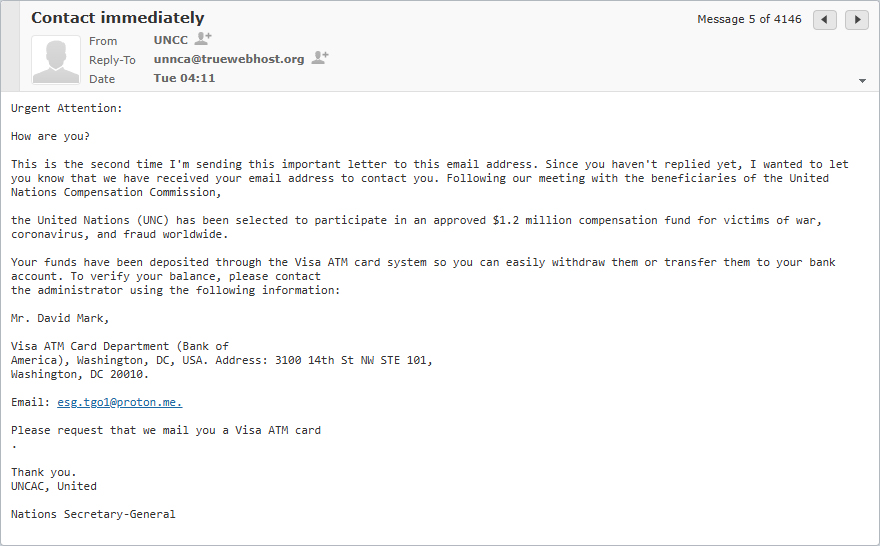
Atención urgente:
¿Cómo está?
Esta es la segunda vez que le envío esta importante carta a esta dirección de correo electrónico. Dado que aún no ha respondido, quería informarle que hemos recibido su dirección de correo electrónico para ponernos en contacto con usted. Tras nuestra reunión con los beneficiarios de la Comisión de Compensación de las Naciones Unidas,
Las Naciones Unidas (CNU) han sido seleccionadas para participar en un fondo de compensación aprobado de 1,2 millones de dólares para las víctimas de la guerra, el coronavirus y el fraude en todo el mundo.
Sus fondos se han depositado a través del sistema de tarjetas Visa para cajeros automáticos para que pueda retirarlos fácilmente o transferirlos a su cuenta bancaria. Para verificar su saldo, póngase en contacto con el administrador utilizando la siguiente información:
Sr. David Mark
Departamento de Tarjetas Visa para Cajeros Automáticos (Bank of America)
Washington, DC, EE. UU.Dirección: 3100 14th St NW STE 101, Washington, DC 20010
Correo electrónico: esg.tgo1@proton.meSolicite que le enviemos una tarjeta Visa para cajeros automáticos por correo.
Gracias
UNCAC, Naciones Unidas
Secretario General de las Naciones Unidas
This message was sent from the fraudulent email address contact@ab.dhlglobalcargo.com, which impersonates DHL and falsely claims affiliation with the United Nations. This is a classic example of how the United Nations Compensation Scam attempts to appear legitimate while using fabricated details, spoofed domains, and forged identities.
Background of the United Nations Compensation Scam
The United Nations Compensation Scam belongs to a long running family of advance fee fraud schemes. These scams promise victims a large financial payout but require small up front payments or the submission of sensitive personal information. Criminals impersonate well known institutions to create a false sense of trust. By pretending to represent the United Nations, they exploit the organization’s global reputation for humanitarian assistance and financial relief programs.
Scammers often claim that victims have been selected for compensation because of one or more of the following events:
- Armed conflict or political instability
- Natural disasters
- Pandemic related hardship
- Online fraud or financial loss
- Economic distress
- Wartime displacement
In reality, the United Nations does not send unsolicited personal compensation awards, does not use private email providers to distribute funds, and does not mail ATM cards to individuals as part of any relief program. The scam is entirely fabricated and is used to steal money, identity documents, and bank information from unsuspecting victims.
How the United Nations Compensation Scam Works
Although these messages vary in language and structure, most versions follow a consistent pattern. Understanding how this scam operates makes it easier to identify and avoid.
Step 1: Initial Contact
The scam begins with an unexpected email claiming to be from the United Nations Compensation Commission or an affiliated humanitarian program. The message may reference a major crisis, such as war or a pandemic, and state that the United Nations has approved funds on your behalf. Scammers frequently use emotional language to create urgency.
Step 2: Official Appearance
To appear legitimate, scammers include:
- Official sounding program names
- Government addresses
- Fake titles and departments
- Logos copied from legitimate organizations
- References to compensation decisions or global relief efforts
The example message mentions the “United Nations Compensation Commission” and claims that an ATM card loaded with more than one million dollars is waiting to be mailed.
Step 3: Financial Lure
The scam promises a large payout. Amounts commonly range from hundreds of thousands to several million dollars. The example message claims a benefit of 1.2 million dollars. This figure is intended to convince victims that the opportunity is life changing and worth pursuing.
Step 4: Instructions to Contact a Fake Administrator
Victims are urged to contact a so called administrator, who is often impersonating a bank representative, a finance officer, or a United Nations official. In the message above, the scammer uses the name “David Mark” and attaches a Washington DC address to create a sense of authenticity.
Step 5: Advance Fee Fraud
Once the victim responds, scammers begin asking for money. These payments may be described as:
- Delivery charges
- Bank activation fees
- Tax payments
- Clearance fees
- Security verification fees
- Anti terrorism checks
- Foreign transaction approvals
Each payment is presented as a small step needed to release the compensation funds. Once paid, scammers continue requesting additional fees until the victim stops responding.
Step 6: Requests for Personal Information
Even victims who do not send money may be asked to provide:
- Passport scans
- Driver’s licenses
- Bank account numbers
- Home addresses
- Phone numbers
This information can be used for identity theft, account takeover attempts, or additional scams.
Investigation of the Fraudulent Domain dhlglobalcargo.com
The example scam email was sent from contact@ab.dhlglobalcargo.com, a suspicious domain intended to mimic DHL. To analyze this further, we used our whois lookup tool to examine the domain registration records.
The domain dhlglobalcargo.com was registered in 2024, long after official DHL domains such as dhl.com and dhlglobalmail.com were created. It was registered through a low cost registrar associated with temporary or disposable domain setups, which is common in scam operations. The domain is not related to Deutsche Post AG or DHL in any way.
Key findings from the whois lookup include:
- Recently registered domain
- No legitimate ownership records
- Hosted by budget friendly or anonymous infrastructure
- Nameservers unrelated to any official DHL network
The subdomain ab.dhlglobalcargo.com does not exist in public DNS records and appears to be spoofed in outgoing emails. Scammers often create fake subdomains to impersonate legitimate organizations while masking their real location.
Website Malware Scan Results
To further evaluate the domain, we used our website malware scanner to test for suspicious activity. The scan detected signs of malicious behavior on the domain, confirming its use in fraudulent operations.
The website does not contain real content. Instead, it loads a default LiteSpeed 404 page. This type of setup is frequently used by cybercriminals who only need the domain for outbound email fraud and have no intention of hosting a legitimate website.
Findings from the scan include:
- Suspicious activity detection
- Generic 404 template
- No real website content
- Likely compromised or intentionally inactive
This behavior is consistent with scam domains that serve as temporary email servers for fraudulent campaigns such as the United Nations Compensation Scam.
Why the United Nations Compensation Scam Is Effective
Despite years of public reporting, this scam continues to thrive. Several psychological factors contribute to its success:
- Authority The scam impersonates one of the most respected global organizations
- Urgency Messages claim immediate deadlines or second attempts to contact the recipient
- Hope Victims dealing with hardship may believe in sudden financial relief
- Fear Scammers warn that delayed responses will result in lost compensation
- Financial reward Large payment amounts make victims more likely to engage
Scammers design these messages to override skepticism and encourage rash decisions.
How To Recognize the United Nations Compensation Scam
There are several clear red flags that consistently appear in scam messages of this type. These include:
- Unsolicited emails about financial awards
- Claims of United Nations compensation programs
- Promises of million dollar ATM cards
- Requests to contact personal email addresses
- Use of free email services or spoofed domains
- Grammatical errors and inconsistent language
- Claims that you were specifically selected without explanation
- Use of non official domain names
The genuine United Nations does not distribute compensation funds via unsolicited email, nor does it ask private individuals to contact secretaries, officials, or administrators through gmail or protonmail accounts.
Risks Associated With the United Nations Compensation Scam
Victims who engage with the scam may face serious consequences, including:
- Financial loss due to repeated advance payments
- Identity theft
- Bank account compromise
- Exposure to additional scams
- Targeted phishing attempts
- Loss of personal privacy
Some victims are re targeted in what is known as a recovery scam, where another scammer pretends to be a law enforcement agent who can help recover the lost funds for an additional fee.
What To Do If You Receive a United Nations Compensation Scam Email
If you receive a suspicious message referencing a compensation award, follow these steps immediately:
- Do not respond
- Do not click links
- Do not provide personal information
- Do not send money
- Mark the message as spam
- Block the sender
If you already interacted with the scam, take the following actions:
Botcrawl may earn a commission from purchases made through links in this article.
- Stop communication immediately
- Contact your bank if you shared financial information
- Monitor accounts for suspicious activity
- Change all affected passwords
- Run a malware scan using trusted software such as Malwarebytes
How To Report the Scam
Reporting helps authorities track fraudulent activity and warn others. You can submit reports to:
- The Federal Trade Commission
- The Internet Crime Complaint Center
- Your local police
- Your email provider’s abuse department
Include the email address, message content, and any suspicious attachments.
How To Protect Yourself From Future Scams
- Use strong spam filters
- Enable multi factor authentication
- Keep software updated
- Never trust unsolicited financial offers
- Verify unexpected messages by researching the claims online
- Use antivirus software and run regular scans with tools such as Malwarebytes
The United Nations Compensation Scam continues to evolve and deceive victims around the world. By impersonating respected institutions and promising large financial rewards, scammers manipulate emotions and exploit trust. Understanding how the scam works, recognizing the warning signs, and adopting basic cybersecurity practices are essential steps in preventing financial loss and identity theft.
For more information about online fraud and safety tips, visit our Scams category and explore related topics in Cybersecurity.