

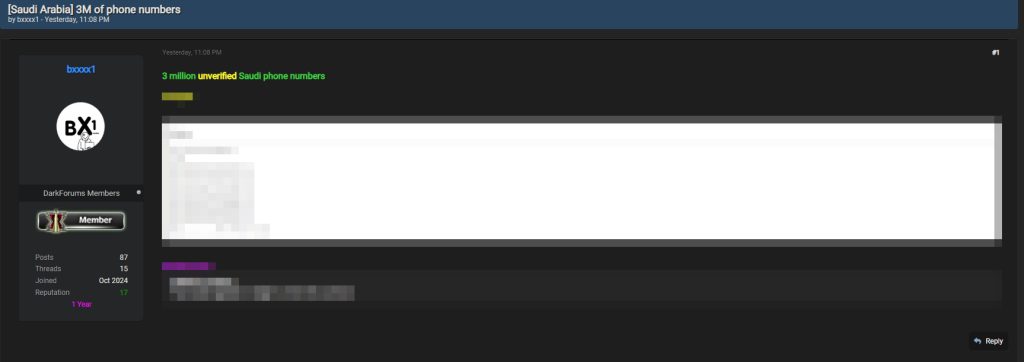
Claims of a Saudi Arabia phone number leak emerged after a forum post advertised “3 million unverified Saudi phone numbers” and presented a small sample formatted with the +966 country code. The same thread indicates the dataset can be downloaded from the forum, and replies show other users acknowledging the release and discussing access to the file.
Because no company, telecom provider, or application is named as the source, this appears to be a bulk phone number exposure event rather than a confirmed breach attribution. Even so, list-style leaks can still create real harm at scale, especially when they circulate widely and are repackaged into spam and fraud campaigns.
The post itself is minimal. It does not include database schema, CSV headers, account identifiers, names, addresses, or any direct explanation of how the dataset was obtained. What it does show is a clear claim of volume, a Saudi Arabia phone number format sample, and a download section that is not visible unless you are logged into the forum.
What The Forum Post Claims
The thread title frames the dataset as “[Saudi Arabia] 3M of phone numbers.” Inside the post, the uploader describes the dataset as “3 million unverified Saudi phone numbers.” A short sample list is shown using the Saudi Arabia country code prefix, which is consistent with standard international formatting for Saudi mobile numbers.
Importantly, the post does not claim the data comes from any specific platform. There is no mention of a breached service, a compromised database, a telecom employee leak, or any named vendor exposure. That absence does not make the dataset harmless. It simply means attribution is unknown, and the risk analysis needs to focus on what a bulk phone number list enables in the real world.
The post also includes a “DOWNLOAD” section presented as hidden content. The forum indicates you must register or log in to view it. In follow-up replies, other users thank the uploader, and at least one reply suggests the file is being actively passed around within the thread, reinforcing that this is not just a claim sitting idle.
Why A Phone Number Leak Still Matters
Some readers assume a phone number list is “low sensitivity” because it does not automatically include passwords or financial data. In practice, phone numbers are one of the most abused identifiers in fraud ecosystems because they are used as identity anchors across dozens of everyday services. They also map cleanly to SMS delivery, which means a list can be weaponized immediately without needing any additional context.
Even when a leak contains only numbers, it can still enable:
- Mass SMS spam: High-volume unsolicited messaging campaigns targeting a specific country and carrier ecosystem.
- Smishing: Fraud messages designed to trick recipients into clicking links, sharing credentials, or installing malicious apps.
- One-time code theft attempts: Social engineering aimed at convincing a user to reveal OTP codes or approve sign-in prompts.
- WhatsApp and messaging app targeting: Saudi-targeted lists often get repurposed into messaging scams because phone numbers double as account identifiers.
- SIM swap targeting: Large lists help criminals scale account takeover attempts, especially when they can pair a number with leaked names from separate sources.
A Saudi Arabia phone number leak also has a geographic targeting effect. Fraud campaigns perform better when they are localized, including language cues, common brand impersonations, and region-specific pretexts. A country-specific list lowers the effort required to build those campaigns.
What Is Actually Known From The Listing
We keep this section strict, because the post itself is strict. Based on what is visible in the thread:
- The uploader claims the dataset contains 3 million phone numbers.
- The uploader describes them as unverified.
- The sample shown uses the +966 country code prefix.
- The dataset is presented as downloadable through the forum’s hidden download section.
- No source organization is named, and no breach narrative is provided.
What is not shown is just as important:
- No file structure details, such as CSV column names, database tables, or export logs.
- No corroborating metadata, such as timestamps, collection dates, carrier tags, or region codes.
- No claims of associated identity fields like names, emails, addresses, or national identifiers.
That pattern fits a “flat list” leak. These lists are often compiled through scraping, aggregation of older leaks, or collection from multiple sources over time. Without attribution, it is not possible to responsibly claim a specific origin.
Understanding The “Unverified” Label
The word “unverified” can mean several things in leak listings, and it is often used as a hedge. It may mean the uploader did not check whether the numbers are active. It may mean duplicates were not removed. It may also mean the list is stitched together from multiple sources and not cleaned.
From a safety standpoint, “unverified” does not remove risk. Fraud operations do not need 100 percent validity. If even a fraction of numbers are active, that is enough to run profitable campaigns at scale. Many spam operations treat delivery failures as normal and simply keep sending until they find live targets.
In other words, a dataset can be messy and still be dangerous, especially when the dataset is large and geographically targeted.
Common Abuse Patterns After Large Phone Number Leaks
When a bulk list like this circulates, the fastest downstream effect is typically an increase in targeted messaging. The attacker does not need to know anything else about the recipient to start. They can test themes, measure responses, and optimize.
In Saudi Arabia, the most common patterns we see after country-targeted list circulation include:
- Bank impersonation: “Account locked” or “verification required” messages that push victims toward credential pages.
- Delivery and logistics scams: Fake package holds, customs fees, or address confirmation requests.
- Government-themed pretexts: Messages implying fines, legal notices, or urgent identity verification steps.
- Telecom support impersonation: Attempts to trick users into sharing account codes or accepting “support” calls.
- Investment and crypto bait: WhatsApp and SMS outreach promising returns, often followed by grooming and payment requests.
A phone number list also becomes more powerful when combined with other leaked data. Threat actors frequently cross-reference numbers against older identity leaks, breached marketing databases, and public social profiles. That is how a “numbers-only” leak becomes personalized fraud.
Why Attribution Is Not Required To Take It Seriously
There is a temptation to dismiss any leak that does not name a company. That is a mistake. Many harmful exposure events never get tied cleanly to a single source because the list is compiled rather than stolen from one database. Users still get hit with the consequences, and the practical response is the same: reduce how easily your phone number can be used to compromise accounts and trick you into sharing access.
This is also why we treat list circulation as a public-risk event even when it is not framed as a “breach.” The outcome for targets can be identical: more scams, more account recovery attempts, more OTP theft attempts, and more attempts to push malware links through localized messages.
Recommended Precautions For Individuals
If your number is a Saudi mobile number, the most effective protection steps focus on reducing the value of SMS-based attacks and tightening account recovery channels.
Start with the basics that actually stop fraud:
- Do not share one-time codes: No legitimate bank, carrier, or government workflow needs your OTP through an unsolicited message or call.
- Avoid logging in through SMS links: If a message claims your account is locked, open the official app or type the official site manually.
- Harden your primary email account: Your email is the real key for password resets. Enable MFA and use a strong, unique password.
- Prefer app-based MFA over SMS: Where possible, use authenticator apps or passkeys instead of text-message codes.
- Expect impersonation attempts: Treat urgent payment demands, “verify now” warnings, and surprise account alerts as hostile by default.
Botcrawl may earn a commission from purchases made through links in this article.
If you clicked a suspicious link or installed anything after receiving an unexpected message, scan your device for malware using a reputable tool such as Malwarebytes. Message-based campaigns frequently use lightweight infection chains that rely on speed and urgency rather than technical sophistication.
Mitigation Steps For Organizations And Security Teams
Organizations operating in Saudi Arabia or serving Saudi customers should treat list leaks as an early warning. Even if your company was not the source, your users may still be targeted with impersonation attempts using your brand.
Practical steps that reduce harm quickly:
- Increase fraud monitoring: Watch for spikes in SMS-related support tickets and authentication failures tied to Saudi numbers.
- Review SMS-based recovery flows: Tighten rate limits, add step-up verification, and reduce reliance on phone numbers as the only identity factor.
- Harden customer communications: Make it easy for users to verify official messages and teach them what you will never ask for.
- Train support staff for OTP scams: Support agents get socially engineered too. Ensure they treat OTP and account recovery requests with strict verification.
- Improve detection for smishing lures: If you run mobile apps, consider in-app warnings when users are sent to suspicious external domains.
For telecom and platform operators specifically, list leaks are a reminder that phone numbers should be treated as sensitive identifiers. Logging, export controls, and internal access audits matter even when the underlying dataset looks “simple.”
What Would Change This From A Leak To A Confirmed Breach
Right now, this is best described as a Saudi Arabia phone number leak because the listing does not identify a source system. If additional evidence later ties the dataset to a specific service, the analysis changes.
The indicators that would strengthen attribution include:
- File metadata showing a named platform, a database export signature, or internal field labels.
- Consistent formatting that maps to a known application’s export layout.
- Internal identifiers, timestamps, carrier tags, or region segmentation that appear tied to a specific source system.
- A parallel disclosure by an organization acknowledging unauthorized access.
Until then, the responsible approach is to focus on user risk and practical mitigation, not speculative origin claims.
Why This Listing Is Still Newsworthy
Large list leaks are not just “noise,” especially when they are framed around a specific country and a specific volume. Whether the dataset is newly collected or recompiled from older sources, the circulation itself is the event. Once a list is shared openly in leak communities, it tends to get mirrored, repackaged, and redistributed across multiple channels.
That is the part that creates real-world harm. A phone number list is easy to reuse, easy to resell, and easy to automate against. Even if only a portion of the numbers are active, the economics still work for fraud operations because the cost to send messages is low and the potential payoff from even a small conversion rate is high.
We will update coverage if the dataset becomes attributed to a specific service, if more structure is revealed, or if additional technical details emerge. More coverage is available in our data breaches and cybersecurity categories.
- ServiceNow Data Breach Exposes Customer Tenants to Unrestricted API Access
- GitHub Data Breach Confirmed After Poisoned VS Code Extension Exfiltrates Internal Repositories
- Vodafone Data Breach Claim Follows LAPSUS$ Data Leak
- Udemy Data Breach Resurfaces as 1.4M Records Circulate on Forum
- ClickUp Data Leak Shows $4B Came Before Customer Security for Over a Year

Related Posts





