Amazon Prime Video Outage Triggers Cyberattack Claims by 313 Team
An Amazon Prime Video outage caused visible service failures across multiple regions, with users encountering temporary unavailability messages, 503 and 504 errors, and a sharp rise in outage reports as the threat actor group 313 Team claimed responsibility for a cyberattack. Prime Video became inaccessible for some users during the disruption, with screenshots circulating online showing temporary unavailability messages, 503 and 504 errors, and failed checks from multiple locations. What remains unclear is whether the outage was caused by a cyberattack, and Amazon has not confirmed that it was.
That distinction is the most important part of this story. Large platforms suffer temporary outages for many reasons, including backend failures, deployment errors, traffic spikes, CDN issues, and infrastructure instability. Threat actors also routinely exploit those same outages by claiming responsibility after the fact, especially when public error pages, global monitoring results, and user-report spikes make the incident easy to package as an attack. In this case, the evidence supports a real Prime Video service disruption. It does not yet prove that 313 Team caused it.
The Amazon Prime Video outage still matters as a cybersecurity story because attribution gaps are part of the modern threat environment. A major service can go down, unofficial claims can spread quickly, and users can be left trying to separate an ordinary infrastructure failure from a hostile operation. That confusion is not harmless. It affects trust, response speed, media coverage, and how quickly false narratives take hold around widely used digital services.
Background on the Amazon Prime Video Outage
Prime Video is one of Amazon’s highest-profile consumer platforms, serving a global audience across web browsers, mobile devices, streaming hardware, and smart televisions. Because of that scale, even a short-lived outage can draw significant attention very quickly. Users do not need a total global collapse to notice something is wrong. A few hundred outage reports, a visible public error page, and inconsistent availability across regions are enough to trigger a broader narrative almost immediately.
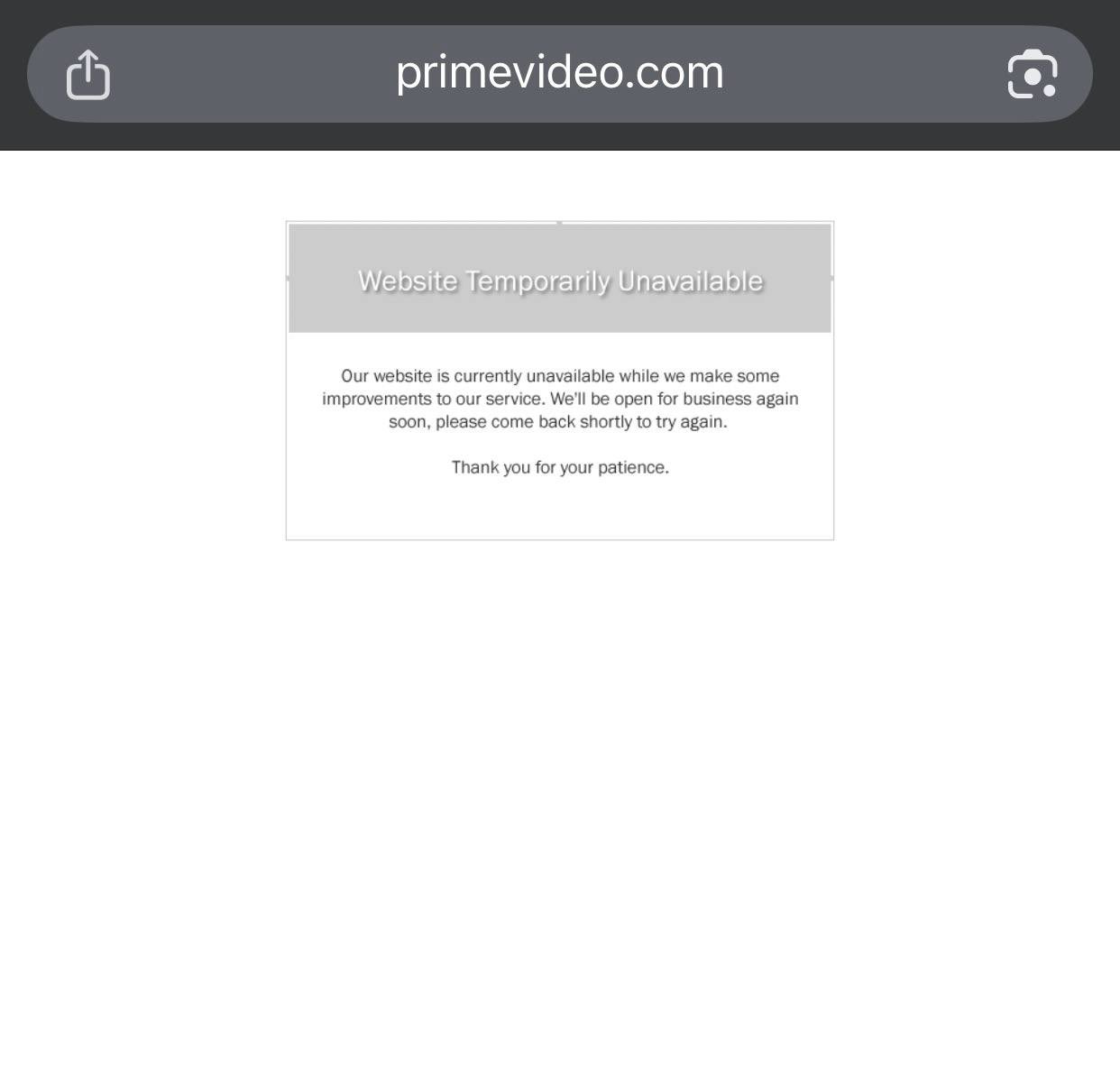
That appears to be what happened here. During the disruption, users reported that Prime Video was unavailable, and screenshots showed a maintenance-style message stating that the website was temporarily unavailable while improvements were being made. Additional checks reviewed by us indicated 503 Service Unavailable responses, 504 Gateway Timeout errors, and connection timeouts from numerous locations. Those signs are consistent with a real service problem, not just a rumor spreading on social media.
The cyberattack angle came from outside Amazon. A post circulating online claimed that 313 Team had targeted Dropbox and Amazon Prime Video in coordinated attacks, alleging internal server disruption, temporary shutdowns, and a roughly three-hour attack duration. The same post also acknowledged that the claims were unverified and that no official confirmation linked the outages to an attack. That caveat matters because it cuts to the core problem in stories like this. Public service failures are observable. Attribution is not.
What the Observed Failures Actually Show
The available signs point clearly to an outage, but not clearly to an attack.
The strongest direct evidence in the Amazon Prime Video outage story is the visible failure behavior itself. Users saw a page stating that the website was temporarily unavailable. Third-party monitoring screenshots showed elevated outage reports over baseline levels. Multi-region checks indicated that some locations were receiving 503 errors, others were timing out, and some were intermittently returning normal responses. That is the pattern of a live availability event affecting at least part of the service footprint.
What that evidence does not show is a confirmed intrusion, a distributed denial-of-service campaign, or any verified malicious action by 313 Team. Error codes such as 503 and 504 are common during infrastructure stress and backend instability. They can appear during cyberattacks, but they can also appear during software faults, origin failures, dependency disruptions, scaling problems, misconfigurations, and overloaded edge paths. The codes themselves do not attribute cause.
That is where many outage stories lose discipline. They treat the existence of service failures as evidence that the loudest public claimant must be telling the truth. That is not how attribution works. A platform can be down and the attack claim can still be false, opportunistic, or impossible to verify from public evidence alone.
Why the 313 Team Claim Should Be Treated Carefully
The 313 Team claim is the most uncertain part of the Amazon Prime Video outage story.
Threat actors and threat-branded accounts frequently claim responsibility for high-visibility outages because the public information environment makes that easy to do. When a major service fails publicly, the error messages are visible, user complaints start flowing, outage trackers light up, and screenshots spread quickly. An actor does not need privileged access to recognize that an outage is underway. They only need to insert themselves into the conversation before verified explanations arrive.
That does not automatically make every claim false. Sometimes threat actors do take credit for real attacks they carried out. The point is that attribution requires more than timing and confidence. It requires evidence linking the claimed actor to the technical cause of the disruption. In this case, that evidence has not been made public.
The post itself effectively admits that. It presents the outage indicators, repeats the cyberattack claim, and then notes that no official confirmation ties the disruption to malicious activity. That means the strongest current reading is still the cautious one. There was an outage. There was also a public cyberattack claim. The second does not yet explain the first.
What a Real Attack Would Need to Show
If the Amazon Prime Video outage were truly caused by a cyberattack, stronger indicators would eventually need to emerge.
That could include an official statement from Amazon acknowledging malicious activity, credible forensic reporting tying the outage to hostile traffic or compromised systems, infrastructure telemetry showing characteristics of a denial-of-service campaign, or supporting evidence from security researchers able to correlate the failure pattern with attack behavior. None of that has been publicly established in the materials reviewed so far.
Without that level of support, the safer conclusion is that the outage cause remains unknown from the outside. That may sound conservative, but it is the only defensible position when attribution evidence is missing. Public outages can originate from internal failures just as easily as external pressure, and large internet services are complicated enough that multi-region errors alone are not proof of hostile action.
This is especially true for consumer streaming platforms. Prime Video depends on a layered service environment that can involve application logic, authentication systems, content delivery infrastructure, traffic routing, backend dependencies, and regional edge behavior. A failure in one layer can create user-visible symptoms that resemble attack impact even when no attacker is involved.
Risks to Users During the Outage
The direct risk to users from the Amazon Prime Video outage appears limited to temporary service disruption based on the current public record. There is no verified indication that user accounts, payment information, or customer data were exposed as part of this incident.
That said, outages still create secondary security risks. Whenever a major service goes down, scammers and opportunistic threat actors often exploit the confusion. Users may receive fake support messages, bogus compensation offers, phony login warnings, or false instructions to verify payment details in order to restore access. A public outage becomes useful bait even if the underlying event had nothing to do with account compromise.
That is one reason the cyberattack rumor itself matters. If enough users believe Prime Video was hacked, some will become more vulnerable to fake Amazon-branded alerts claiming their account was affected. This is how ordinary outages can turn into phishing opportunities. The social engineering layer arrives after the service failure, using the outage headlines as credibility.
Operational and Reputational Implications for Amazon
For Amazon, the Amazon Prime Video outage raises two different issues at once: service resilience and information control.
The first is technical. Any visible multi-region service failure on a major streaming platform raises questions about redundancy, backend stability, deployment discipline, and incident response speed. Even if the disruption is short, a high-profile consumer platform is judged not only by uptime but by how smoothly it recovers and how consistently it behaves across regions during failure.
The second is reputational. When a major service goes down and there is no immediate authoritative explanation, third parties rush in to frame the event. That is exactly what happened here. A threat actor claim filled the silence and introduced a cyberattack narrative before any verified public attribution existed. Once that happens, the company has to deal not only with the outage itself but with the perception that it may be hiding or minimizing something.
That kind of ambiguity is costly even when the eventual explanation is mundane. Users remember the confusion, not just the downtime. If a company wants to limit rumor-driven narratives after outages, clear communication has to be part of incident response, not an afterthought.
Possible Technical Causes Beyond a Cyberattack
There are several plausible non-attack explanations for the Amazon Prime Video outage based on the visible symptoms.
A backend service issue could trigger the kind of temporary unavailability page users saw. A deployment or configuration problem could create intermittent regional failures. A dependency issue affecting authentication, content delivery, or request routing could produce a mix of 503 and 504 responses depending on location and timing. Capacity stress or internal service degradation could also lead to inconsistent behavior across regions without any malicious trigger at all.
None of those possibilities can be confirmed from public screenshots alone. The point is that they are technically ordinary explanations for the exact symptoms that were observed. That is why outage attribution should not be reverse-engineered from an error code and a social media post.
The fact that some locations appeared to return normal responses while others produced failures also fits a broad range of infrastructure scenarios. Streaming platforms often fail unevenly because the internet is not one machine. Different edges, regions, backends, and cache states can produce different results at the same moment. That kind of mixed regional behavior is common during service incidents.
Mitigation Steps for Amazon
Amazon should treat the Prime Video outage as both a service event and a narrative-control event. On the technical side, the company should conduct a full incident review covering the affected time window, the systems that generated the user-facing unavailable page, the origin of the 503 and 504 conditions, and whether any hostile traffic or malicious activity was detected during the disruption.
If no cyberattack occurred, saying so clearly would help limit rumor-driven escalation. If malicious activity was detected, users deserve a more precise explanation than silence while unsupported claims circulate online. In either case, transparency about the cause category would be more useful than allowing unverified threat-actor branding to define the story.
Operationally, Amazon should also evaluate how quickly its public-facing messaging reflected the outage. When users are left to rely on screenshots, downtime trackers, and threat-themed accounts for answers, the company cedes too much of the incident narrative to outside speculation.
Recommended Actions for Prime Video Users
Users do not need to panic about the Amazon Prime Video outage, but they should be cautious about what follows it.
Useful steps include:
Botcrawl may earn a commission from purchases made through links in this article.
- Be skeptical of emails, texts, or messages claiming your Prime Video account was affected by a hack unless they can be verified through official Amazon channels
- Do not click links promising outage compensation, account restoration, or urgent login verification
- Check Prime Video directly through the official app or website instead of relying on social media claims about account status
- Use strong unique passwords for Amazon accounts and enable additional account protections where available
- If you clicked suspicious links during the outage confusion, scan your device with a trusted security tool such as Malwarebytes
For most users, the main practical impact was likely temporary inability to watch content. The larger risk comes afterward, when public confusion about an outage is reused for scams.