OpenAI is expanding the GPT-5 ecosystem with the introduction of GPT-5.1 and the new GPT-5-Codex-Mini model. The company confirmed that GPT-5.1 will launch in multiple tiers, including GPT-5.1 (Base), GPT-5.1 Reasoning, and GPT-5.1 Pro, while the lightweight GPT-5-Codex-Mini will offer up to four times more usage than the standard Codex model. These developments mark OpenAI’s next major step in scaling its AI products for developers, researchers, and enterprise users.
Sources close to the company report that GPT-5.1 models are already being uploaded to Microsoft Azure servers, signaling that the public rollout is only weeks away. The release continues OpenAI’s steady update cycle, which typically delivers new models every three to four months. GPT-5 was released on August 7, 2025, and GPT-5.1 follows as a mid-cycle enhancement with improvements in reasoning, latency, and safety systems.
GPT-5.1 Expands the OpenAI Model Family
The upcoming GPT-5.1 lineup includes three versions tailored for different use cases:
- GPT-5.1 (Base): The general-purpose model optimized for text, analysis, and creative tasks with faster output and improved factual accuracy.
- GPT-5.1 Reasoning: Designed for logic-heavy workloads, problem-solving, and code interpretation with more advanced reasoning capabilities.
- GPT-5.1 Pro: The top-tier model for $200 per month, featuring higher context limits, faster response times, and enterprise-grade priority processing.
While GPT-5.1 is not expected to overhaul the architecture of GPT-5, early reports suggest major quality-of-life improvements for developers and researchers. These include better multi-step reasoning, higher context retention, and enhanced moderation tools for health and safety-related prompts. The GPT-5.1 Pro version also introduces new performance limits, giving professionals faster model access and longer input handling for complex workflows.
GPT-5-Codex-Mini: Efficient Coding with 4x More Usage
Alongside the main GPT-5.1 update, OpenAI officially unveiled GPT-5-Codex-Mini — a smaller, cost-efficient version of the Codex model. The company described it as a compact AI system built to handle most code-related tasks while offering dramatically higher usage limits. In an announcement on X (@OpenAIDevs), OpenAI Developers wrote:
“GPT-5-Codex-Mini allows roughly 4x more usage than GPT-5-Codex, at a slight capability tradeoff due to the more compact model. Available in the CLI and IDE extension when you sign in with ChatGPT, with API support coming soon.”
GPT-5-Codex-Mini is designed to keep developers productive during peak usage periods. When users reach 90 percent of their Codex rate limits, the system will automatically suggest switching to Codex-Mini, extending coding sessions without interruption. The model performs nearly as well as the standard GPT-5-Codex while maintaining exceptional accuracy in most programming languages and software development tasks.
Benchmark Results: High Accuracy and Efficiency
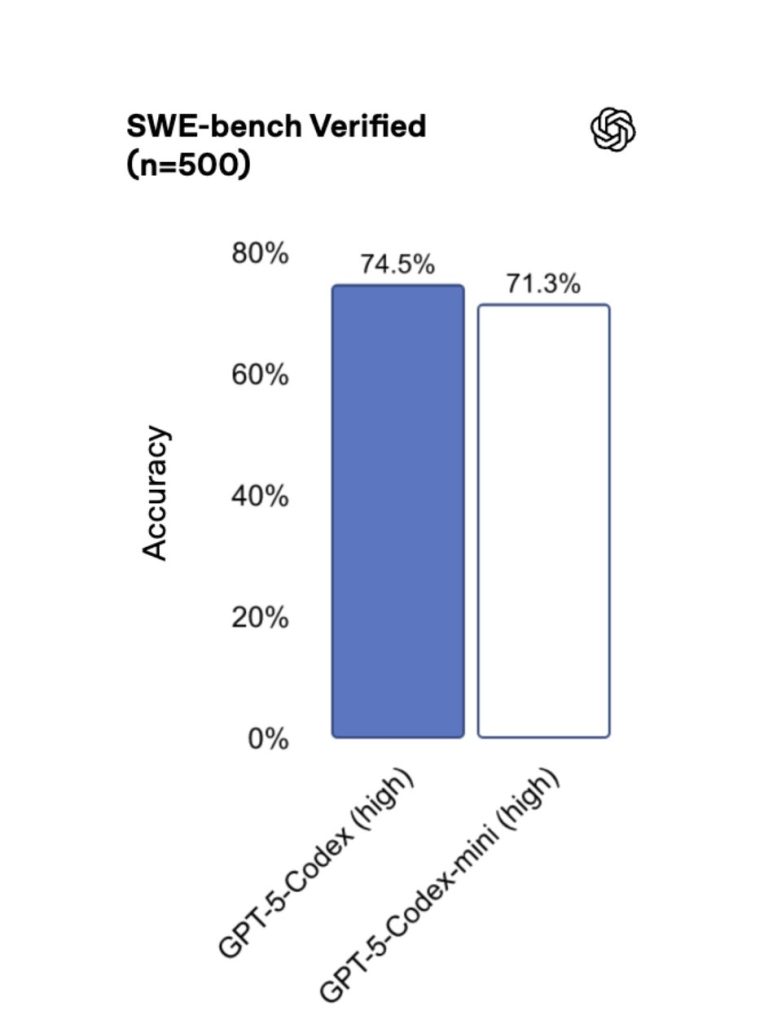
In recent tests using the SWE-bench Verified benchmark (a 500-sample dataset used to evaluate automated software engineering), GPT-5-Codex achieved 74.5 percent verified accuracy. GPT-5-Codex-Mini followed closely with 71.3 percent accuracy, demonstrating near-equal problem-solving capability despite being a smaller model. These results confirm that Codex-Mini retains strong coding performance while offering developers a longer runtime and more affordable scaling option.
ChatGPT Plus, Business, and Education subscribers will receive a 50 percent rate limit increase with the new Codex-Mini system, while Pro and Enterprise users gain priority processing for faster task completion. OpenAI’s internal data shows that Codex-Mini can sustain higher workloads with reduced infrastructure costs, making it ideal for both small teams and enterprise-scale projects.
Deployment and Availability
OpenAI’s integration of GPT-5.1 and GPT-5-Codex-Mini into Microsoft Azure suggests that deployment is imminent. Historically, once models are pushed to Azure environments, public access follows within a few weeks. GPT-5.1 will power future versions of ChatGPT and the Azure OpenAI Service, while GPT-5-Codex-Mini will support GitHub Copilot and developer tools integrated into Visual Studio and other IDEs.
OpenAI is also preparing to extend Codex-Mini to its public API, allowing developers to incorporate the model directly into software products, automation scripts, and AI-assisted coding environments. The company aims to make Codex-Mini the default option for lightweight coding workloads, helping users conserve tokens and reduce latency while maintaining code quality.
Focus on Developer Productivity
The GPT-5-Codex-Mini release represents a major shift toward scalable, developer-friendly AI. Its ability to handle four times the workload of standard Codex allows programmers to build, test, and debug applications without the usual constraints of rate limits or processing delays. Codex-Mini is available through the ChatGPT IDE extension, the command-line interface, and soon via API integration.
By balancing power and efficiency, Codex-Mini gives developers a sustainable way to deploy AI coding tools at scale. It supports automation for backend development, frontend design, data analysis, and embedded systems programming. The model’s compact architecture is optimized for quick responses, making it ideal for local development workflows and collaborative environments where speed is essential.
GPT-5.1 Reasoning and Pro-Level Capabilities
Beyond coding, GPT-5.1 introduces enhanced reasoning abilities that improve step-by-step logical understanding. The GPT-5.1 Reasoning model is designed to reduce errors in multi-stage problem solving, mathematical proofs, and decision-based analysis. It is also better equipped to understand structured data, interpret documents, and manage extended dialogues with minimal context loss.
Meanwhile, GPT-5.1 Pro targets enterprise and research institutions that require high-performance infrastructure. It provides longer context windows, reduced latency, and higher priority access to OpenAI’s servers. Priced at $200 per month, the plan caters to developers, analysts, and organizations managing complex or large-scale AI workloads.
Competition from Google, Anthropic, and Meta
OpenAI’s upcoming releases arrive during an increasingly competitive period in the AI industry. Google is testing Gemini 3 Pro, Anthropic is developing a new version of Claude, and Meta is refining its Llama 4 research model. These companies are racing to improve reasoning efficiency, multimodal capability, and context awareness in their respective systems.
OpenAI’s focus on balancing accessibility and power through products like GPT-5.1 and Codex-Mini helps the company maintain its leadership position. By offering both reasoning-optimized and developer-optimized models, OpenAI appeals to a broader audience ranging from casual ChatGPT users to advanced machine learning engineers.
The Road Ahead
The GPT-5.1 family and GPT-5-Codex-Mini mark a new phase in OpenAI’s development roadmap. Each model continues the company’s trend toward faster, more efficient, and safer systems. The Codex branch remains at the forefront of AI-assisted programming, powering millions of developers worldwide through GitHub Copilot and ChatGPT’s integrated coding tools.
As OpenAI continues to refine GPT-5.1 and prepare for future updates, these innovations show the company’s commitment to scalability and reliability. With Codex-Mini offering high-volume access and GPT-5.1 delivering enhanced reasoning power, OpenAI’s ecosystem is becoming more versatile than ever for real-world applications.
For continued coverage on the latest developments in coding tools, AI models, and emerging technologies, visit Botcrawl’s artificial intelligence section.
- Manus Removes Customer Support From Its App
- Manus Shutdown Will Take Customer Websites and Apps Offline
- Meta Cuts Ties With Manus After China Orders Reversal of $2 Billion AI Deal
- Claude Fable 5 Jailbreak Exposes Weakness in Anthropic’s Guardrails
- Manus AI Has a Refund Problem, Not Just a Product Problem

Related Posts