
Rizee data breach allegations emerged after a threat actor advertised a 1.59 GB SQL database for sale on a forum, claiming it contains 11,873,231 user records tied to the platform. The seller describes the archive as a raw export of a production user table and provided sample SQL rows that appear to reflect structured student account data. If authentic, the Rizee data breach would expose a large population of student users and raise familiar, system-wide concerns about how education platforms secure identity data, credentials, and device-linked authentication artifacts.
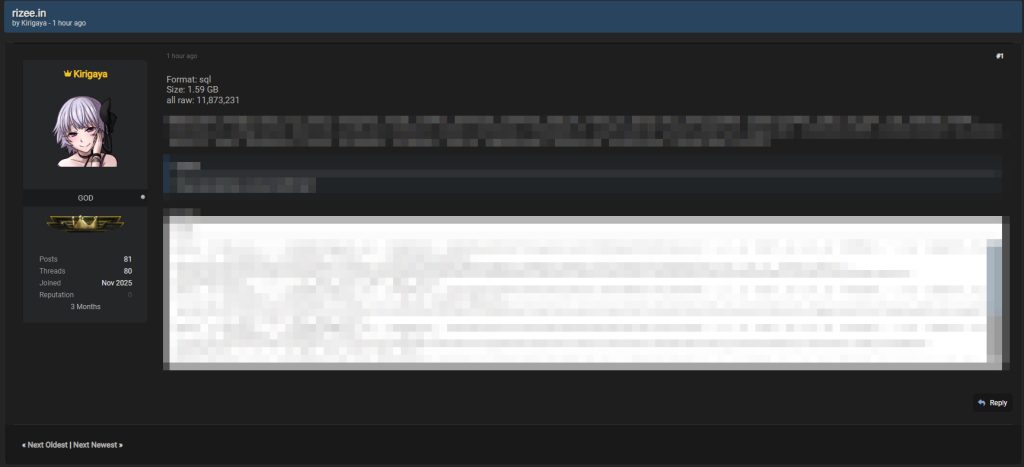
The sample shown in the listing references a table labeled student_users and presents fields consistent with account management and progress tracking systems. The advertised dataset appears to include both standard identity fields and security-sensitive items such as password hashes and session-related tokens. While we have not validated the full database contents, the schema detail disclosed in the sample is sufficient to evaluate likely risk categories and the types of downstream abuse typically associated with large SQL exports.
Large student platform exposures are rarely limited to nuisance spam. When contact details, password hashes, and token material appear together in a single database export, the incident can create long-tail risk that persists well beyond initial disclosure. Even when password storage uses modern hashing, leaked records often become fuel for credential reuse attacks, targeted phishing, and identity profiling that can affect users across multiple services.
Background on Rizee
Rizee positions itself as an AI-powered learning and progress tracking platform designed to support students preparing for competitive entrance examinations. The service is associated with exam preparation workflows for JEE, NEET, EAMCET, and KCET, which typically involve structured practice tests, performance analytics, and personalized study plans delivered through web and mobile applications.
Platforms built around high-stakes exam preparation tend to collect a wide range of data. Beyond basic account creation, many services store exam preferences, target year information, class mapping, institutional identifiers, and device metadata used for login persistence and notification delivery. That breadth can improve personalization, but it also increases the sensitivity of any database compromise because it combines identity, academic context, and authentication elements in one place.
If the Rizee data breach claim is accurate, the record count suggests this is not a small subset of accounts. A database export of this size typically indicates broad access to a primary user table, a reporting replica, or a centralized storage layer used by the platform’s application stack.
Allegedly Exposed Data
The advertised SQL export includes a schema that appears to cover identity, account status, learning context, and application security fields. Based on the sample shown in the listing, the dataset may include the following categories:
- Full names
- Email addresses
- Mobile phone numbers
- Password hashes stored using bcrypt
- User level, class identifiers, and exam identifiers
- Target year values associated with exam preparation
- Email and mobile verification flags
- Institution identifiers and related affiliation fields
- College or branch naming fields
- IP address fields associated with account activity
- Device identifiers used by mobile applications
- Notification tokens used for push messaging
- JWT-style tokens and session-related fields
- Access and refresh token fields
The presence of bcrypt password hashes indicates passwords were not stored in plaintext. That is a meaningful control, but it does not eliminate user risk. Password hash exposure is still valuable to attackers because it enables offline cracking attempts and, more importantly, it enables targeted credential reuse campaigns against other services when users recycle passwords.
Token and device metadata raises separate concerns. If a platform stores long-lived refresh tokens, notification tokens, or device IDs in a user table, exposure can increase the likelihood of account takeover attempts and social engineering. Even when tokens are expired, their presence provides attackers with information about how authentication is implemented and what types of artifacts the platform relies on.
Risks to Students and the Public
If verified, the Rizee data breach could impact a large number of student users. The immediate and most likely risks involve phishing and account takeover campaigns built on exposed contact details and password reuse habits.
Key risk categories include:
- Targeted phishing: Email campaigns that reference exam preparation, test access, subscription renewals, or account verification to lure students into credential entry pages.
- SMS scams: Mobile numbers enable high-volume smishing operations that can be harder for users to distinguish from legitimate notifications.
- Credential reuse attacks: Attackers frequently test leaked email and password combinations across common services, even when the original platform stored hashes.
- Identity profiling: Names, target year, class identifiers, and institutional fields can be combined to build a profile used for more convincing pretexts.
- Account recovery abuse: When attackers have name, phone, and email, they can attempt recovery workflows on unrelated services that rely on personal data verification.
The platform context matters. Education platforms are often trusted by users, and notifications are expected. That reduces friction for attackers. A message that appears to come from a learning platform is less likely to be treated with suspicion than a generic financial scam.
Even if the dataset does not include financial details, identity data and account artifacts can still lead to financial harm indirectly through downstream compromise of other accounts, especially email inboxes used for password resets.
Mitigation Steps for Rizee
If the organization is investigating an incident consistent with this claim, response priorities should focus on containment, validation, and reducing the usefulness of any exposed authentication artifacts. The most effective actions are the ones that remove attacker advantage quickly and measurably.
- Establish scope and timeline: Identify which systems were accessed, whether the export came from a production database, a replica, or a backup pipeline, and determine the earliest point of unauthorized access.
- Revoke tokens at scale: Invalidate active refresh tokens and session tokens associated with users. Rotate signing keys where JWT tokens are used, and confirm that token revocation is effective in production.
- Force credential resets: Require password changes for all accounts potentially included in the dataset. Enforce stronger password rules and rate-limit authentication endpoints to reduce credential testing.
- Harden administrative access: Reset credentials for privileged accounts, require multi-factor authentication, and review the principle of least privilege for database and cloud access.
- Audit database and export activity: Review logs for large queries, unusual dump activity, backup access anomalies, and unexpected outbound transfers. Add monitoring for future bulk export indicators.
- Review storage and backup security: Ensure dumps and backups are encrypted, access-controlled, and not exposed through public links or weak permissions.
- Secure notification infrastructure: Rotate notification keys or tokens where applicable and review how push tokens are stored and used to reduce misuse potential.
- Prepare clear user communications: If exposure is confirmed, provide direct guidance that explains what data was involved and what users should do immediately.
Because the sample includes device and token-related fields, token revocation and signing key rotation should be treated as critical, not optional. Even if tokens are short-lived, rotating keys can limit the risk of replay or misuse if attackers obtained more than a static database dump.
Recommended Actions for Affected Individuals
Most users will not know whether their account was included until the organization issues a notice or confirms the incident. Still, there are practical steps that reduce risk immediately, especially for users who reuse passwords or rely on a single email inbox for multiple services.
Botcrawl may earn a commission from purchases made through links in this article.
- Change passwords and stop reuse: If you used the same password on other services, change those passwords first, starting with your email account. Use unique passwords for important logins.
- Enable multi-factor authentication: Turn on MFA for email, payments, and any service that supports it. MFA reduces account takeover risk even when passwords are compromised elsewhere.
- Watch for exam-themed phishing: Treat unexpected messages about exam results, mock test access, subscription renewal, or verification as suspicious, especially if they include links or request credentials.
- Be cautious with SMS links: Smishing is common after large exposures. Do not trust shortened links or urgent claims about account suspension.
- Monitor for account recovery attempts: Unexpected password reset emails or verification codes can indicate someone is trying to access your accounts.
- Scan devices if you interacted with suspicious links: If you clicked links or installed apps in response to an exam-themed message, scan your device for malware using a reputable tool such as Malwarebytes.
For students, the safest approach is to avoid logging in through links delivered by email or SMS. Use the official application or type the official domain directly. That single habit prevents a large portion of credential theft attacks that rely on spoofed login pages.
What Is Known and What Remains Unverified
Claims of this type should be treated with care. The listing includes specific values for file size and record count and provides sample SQL rows and a table name. Those details increase credibility, but they do not replace confirmation from the organization or independent validation of the full dataset.
What is concrete within the claim is the structure presented: a raw SQL export with fields that include identity data, bcrypt password hashes, and token-related values. What remains unverified is whether the full dataset matches the claimed record count, whether it reflects current users, and whether any of the tokens shown are valid or were already expired at the time of extraction.
Even with those unknowns, the risk analysis does not change materially. A dataset with contact details and hashed credentials can still drive phishing and credential reuse campaigns. Token fields, even expired ones, signal that the export likely came from a live application environment rather than a limited marketing list.
Broader Implications for Education Platforms
This incident claim reflects a broader pattern affecting education technology providers. Platforms that serve students at scale often move quickly, integrate multiple services, and rely heavily on mobile application ecosystems that generate large volumes of device metadata and authentication artifacts. That creates a wide attack surface that includes application code, APIs, storage layers, backup pipelines, and administrative consoles.
For high-scale learning platforms, security posture cannot be treated as a back-office function. Token management, access control, export monitoring, and backup protection are core safety features. When those controls fail, exposures can affect students who are already under pressure and more likely to respond quickly to urgent messaging.
Whether or not the Rizee data breach claim is ultimately confirmed, the scenario reinforces a simple reality: platforms that store identity and authentication artifacts together must assume that a database dump will be weaponized quickly and in multiple ways. Defensive design should focus on limiting the usefulness of stolen data through strong hashing, short-lived tokens, rapid revocation, and strict control over bulk export paths.
Additional coverage is available in our data breaches reporting and our cybersecurity category.
- ServiceNow Data Breach Exposes Customer Tenants to Unrestricted API Access
- GitHub Data Breach Confirmed After Poisoned VS Code Extension Exfiltrates Internal Repositories
- Vodafone Data Breach Claim Follows LAPSUS$ Data Leak
- Udemy Data Breach Resurfaces as 1.4M Records Circulate on Forum
- ClickUp Data Leak Shows $4B Came Before Customer Security for Over a Year

Related Posts