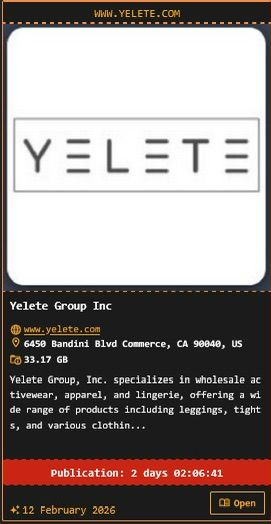
A claim of a Yelete data breach has surfaced after the DragonForce ransomware group reportedly listed the U.S.-based apparel company and alleged the theft of 33.17GB of data, with an intent to publish within 2 to 3 days. The claim has not been independently verified, and no public confirmation from Yelete has been identified at the time of writing.
Yelete is known in the apparel space for wholesale-focused products that span activewear and everyday basics, which typically means a mix of vendor relationships, distributor contacts, product catalogs, pricing documents, shipping workflows, and internal operational records. When ransomware groups claim to have exfiltrated data from companies in this segment, the business risk often centers on supplier impersonation, invoice manipulation, and exposure of commercially sensitive documents, not just disruption from encryption.
Background On Yelete
Yelete operates as a U.S.-based fashion and apparel brand with a wholesale emphasis, supplying retailers and partners with a broad assortment of clothing categories. Apparel wholesalers and manufacturers usually maintain large volumes of operational documents that move between internal teams and external partners, including purchase orders, packing lists, invoices, vendor onboarding forms, and seasonal product line materials. Those files do not always look “sensitive” at first glance, but they can be extremely useful to criminals when building believable business email compromise and payment diversion schemes.
Because fashion supply chains rely on frequent communications, recurring invoices, and time-sensitive delivery schedules, even a short incident window can create confusion that attackers exploit. In many ransomware incidents involving wholesalers, the follow-on scams show up after systems come back online, when staff are catching up on delayed orders and vendors are trying to re-sync transactions.
What The DragonForce Ransomware Claim Says
The DragonForce claim, as presented in circulating victim notes, alleges 33.17GB of stolen data and indicates an intent to publish within approximately 2 to 3 days. A short publication window is a standard extortion pressure tactic. It does not confirm the claim on its own, but it does signal that the group is attempting to force a rapid negotiation timeline.
At this stage, there are two big unknowns. First is whether the group actually accessed Yelete’s internal files or whether the listing is mislabeled or exaggerated. Second is what “33.17GB” represents, because ransomware actors often inflate or round dataset sizes, and the most harmful material is frequently a small subset of what gets stolen.
What “33.17GB” Usually Means In A Wholesale Apparel Environment
In retail and wholesale breaches, a dataset in the tens of gigabytes is often a mix of everyday business content. That can include PDFs, spreadsheets, archived email attachments, photos used for catalogs, and exports from inventory or order management platforms. It can also include older backups that happen to be stored on file servers or shared drives.
If the claim is legitimate, the most likely categories of exposed data in a business like Yelete include:
- Partner and retailer contact data such as names, emails, phone numbers, and shipping addresses tied to accounts.
- Invoices, purchase orders, and payment records that can be used to craft fraudulent “updated banking details” messages.
- Pricing lists and contract documents that reveal margins, distributor terms, and negotiated rates.
- Shipping and logistics files including packing lists, tracking references, and warehouse workflows.
- Internal HR or administrative documents that may contain employee information, depending on where the intrusion landed.
The presence of any customer payment information is not established by the current claim. Ransomware groups frequently use broad language even when they only have operational documents. Verification normally requires proof-of-life that can be assessed without spreading private information.
Why This Claim Could Be Real
Wholesalers and apparel supply businesses often rely on a patchwork of systems, shared drives, third-party logistics, and vendor portals. That environment can create common initial access paths, including compromised credentials, reused passwords, exposed remote management services, or phishing that targets accounting and fulfillment teams.
Ransomware groups also favor companies with time pressure. In fashion and wholesale, missing a shipping window or disrupting orders during a busy cycle can create immediate financial pain. Even if the stolen data is mostly operational, the threat of publication is often enough to force urgent executive attention.
Why This Claim Might Be Exaggerated Or Misleading
A ransomware listing is not a confirmation by itself. Some groups post victims with minimal proof, sometimes to test whether the organization will respond. In other cases, data comes from a compromised supplier or third-party service, and the victim name gets used even when the compromise did not originate inside that company’s environment.
Another reason to be cautious is that the published size and timeline can be part of the intimidation strategy. A countdown can be reset, delayed, or quietly removed. Some actors never publish at all if they do not have credible materials to release.
Business Risks If Data Is Published
If DragonForce publishes files, the most immediate risk is not always mass identity theft. In a wholesale apparel context, the higher-probability risks are targeted fraud and disruption of commercial relationships.
- Vendor impersonation and payment diversion using stolen invoices, branding, and account context.
- Retailer and partner phishing referencing real orders, shipments, or product lines to appear legitimate.
- Contract and pricing exposure that can damage negotiations or reveal sensitive business terms.
- Employee targeting if internal org charts, emails, or HR records are included in the stolen files.
In many ransomware incidents, criminals also exploit post-incident confusion, sending “resend payment” or “new bank details” emails while teams are recovering and processing delayed transactions.
Mitigation Steps For Yelete
Only Yelete can confirm scope, but these are the response steps that typically matter most when dealing with an extortion-style claim that includes possible data theft.
- Confirm whether encryption occurred, data exfiltration occurred, or both, and establish a timeline of unauthorized access.
- Reset credentials and invalidate sessions across identity providers, email, VPN, admin consoles, and file sharing platforms.
- Audit finance and AP workflows for invoice manipulation attempts and require secondary verification for any banking changes.
- Review access logs for shared drives, cloud storage, and ERP or order systems that store partner data and invoices.
- Prepare partner communications that warn about payment diversion scams and impersonation attempts using real invoices.
- Engage independent incident response support for containment, validation, and data exposure assessment.
Recommended Actions For Partners And Customers
Retailers, suppliers, and logistics partners should treat unexpected payment changes and urgent invoice requests with extra scrutiny during the next several days, especially if any messages appear to reference real Yelete order details.
Botcrawl may earn a commission from purchases made through links in this article.
- Verify any banking or payment detail changes using a known phone number or existing vendor portal process.
- Be cautious of emails that include invoices, shipping documents, or “reissued” payment requests.
- Require internal approval for wire transfers or ACH updates tied to Yelete or related accounts.
- Report suspicious messages that use Yelete branding or reference real order identifiers.
- If a device opens an unexpected attachment or link, run a malware scan using a trusted tool such as Malwarebytes.
What To Watch Next
The key verification point will be whether DragonForce publishes proof-of-life materials that can be validated as belonging to Yelete without distributing private information. If publication occurs, the nature of the released files will determine the real risk profile, whether it is mostly operational documents, or whether it includes partner data, contracts, and internal administrative records.
As more details become available, the most useful signals will be specificity, document authenticity, and whether Yelete issues a public incident notice or partner advisory. Additional breach reporting is available in data breaches and broader coverage appears in cybersecurity.
- ServiceNow Data Breach Exposes Customer Tenants to Unrestricted API Access
- GitHub Data Breach Confirmed After Poisoned VS Code Extension Exfiltrates Internal Repositories
- Vodafone Data Breach Claim Follows LAPSUS$ Data Leak
- Udemy Data Breach Resurfaces as 1.4M Records Circulate on Forum
- ClickUp Data Leak Shows $4B Came Before Customer Security for Over a Year

Related Posts