

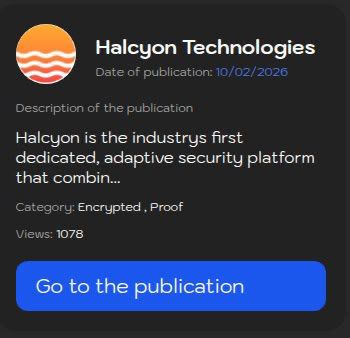
The Halcyon data breach claim is circulating after the Sinobi ransomware group reportedly listed Halcyon Technologies as a victim and alleged the theft of roughly 270GB of data, with a stated intent to publish within about 9 to 10 days. The claim has not been independently verified, and no public confirmation from Halcyon has been identified at the time of writing.
Halcyon is a U.S.-based cybersecurity vendor that positions its platform as purpose-built for ransomware resilience and recovery. That context matters because ransomware groups increasingly use “name value” as leverage, and targeting a security company can generate disproportionate attention even when the underlying dataset is unclear.
Background On Halcyon
Halcyon markets itself as a dedicated anti-ransomware platform, focused on stopping ransomware activity and enabling recovery without paying extortion demands. The company presents its approach as combining prevention engines with AI models and claims capabilities designed to detect encryption behavior and reduce downtime. Those positioning statements are central to why a ransomware listing involving Halcyon draws attention across the security community, even before the details are validated. Halcyon’s company overview describes the platform and leadership background in more detail.
In parallel, Halcyon also publishes ransomware research and threat group profiles, including material focused on Sinobi and other groups. That public-facing research posture can make the company a visible target, and it also means any alleged leak can quickly become entangled with broader narratives about “turning the tables” on security vendors, regardless of what the stolen data actually contains. Halcyon’s ransomware research center outlines the company’s tracking and analysis initiatives.
What The Sinobi Ransomware Claim Says
The Sinobi claim, as summarized in circulating incident notes, alleges that Halcyon Technologies was compromised and that approximately 270GB of data was exfiltrated. The same notes indicate a publication window of roughly 9 to 10 days, which aligns with common “countdown” pressure tactics used in double extortion campaigns. At this stage, the claim should be treated as unverified until there is either victim confirmation or sufficient proof-of-life materials to support the allegation.
When ransomware groups list a victim, the presence of a countdown alone does not validate the underlying compromise. Many leak sites publish minimal context, sometimes including only a victim name, industry tag, and a data size figure. The most credible listings typically add corroborating artifacts over time, such as file trees, screenshots of internal systems, small sample archives, or documents with internal metadata that can be validated without distributing sensitive content.
How Sinobi Typically Operates
Sinobi has been described by multiple security sources as a ransomware operation with a modern double extortion model, where data theft is used to amplify pressure beyond encryption. The group has been characterized as selective in targeting and focused on leverage, with tactics that emphasize quiet intrusions and high-impact publication threats. Those patterns matter here because a listed data volume can be used as psychological leverage even when the most damaging component is a smaller subset of sensitive files. Barracuda’s threat analysis describes Sinobi as a hybrid ransomware-as-a-service style operation with an emphasis on stealth and leverage. Barracuda’s Sinobi overview provides additional context on the group’s positioning and tactics.
Other threat intelligence write-ups have discussed overlap and suspected lineage relationships between Sinobi and earlier ransomware brands, a common pattern in the ransomware ecosystem when groups rebrand to evade disruption or distance themselves from prior exposure. One example analysis notes similarities in tooling and leak-site structure compared to earlier operations. SOS Ransomware’s profile describes suspected overlap and broader context.
What “270GB” Could Actually Represent
Ransomware groups routinely describe stolen material in terms of total gigabytes, but that number can be misleading. “270GB” might represent any combination of user home directories, shared drives, ticketing exports, logs, engineering artifacts, marketing collateral, internal documents, and compressed archives. It can also include duplicates, virtual machine images, backups, or bulk collections that inflate volume without increasing sensitivity.
In a cybersecurity company context, the most consequential exposure is often not “product code” as a headline, but rather operational and customer-related material. That can include internal support communications, incident response notes, configuration details, customer contacts, sales contracts, and security documentation. Even if core product systems are not affected, ransomware actors frequently target identity systems and file repositories that contain high-leverage documents.
Why This Claim Could Be Real
Security vendors are not immune to ransomware. Like any modern organization, they rely on SaaS platforms, endpoint fleets, identity systems, third-party integrations, and distributed internal tooling. A single compromised credential, exposed remote access surface, or misconfigured cloud permission can create an entry point that has nothing to do with the vendor’s product quality.
There is also a strategic incentive for ransomware groups to target security companies. Even a partial compromise can be used for narrative impact, intimidation, recruitment signaling, or extortion. If Sinobi has indeed obtained internal files, the group may attempt to frame the leak as “proof” that defensive claims are meaningless, even though the real-world lesson is usually more mundane and rooted in access control and identity compromise.
Why This Claim Might Be Exaggerated Or Misleading
Ransomware leak posts can be opportunistic, and the existence of a listing does not confirm a breach. Groups sometimes mislabel victims, post stale data, or conflate a vendor with an unrelated organization that shares a similar name. “Halcyon” is also a term used by multiple entities across sectors, which increases the importance of validating that the listed victim is actually the cybersecurity company operating at halcyon.ai.
Another common issue is that some actors publish “teaser” listings to test whether a victim will engage. In those cases, proof-of-life appears later, or not at all. The most credible path to verification typically involves either a direct statement from the victim organization or evidence that can be validated without spreading sensitive information. At the moment, the publicly described details remain high-level.
Potential Risks If The Halcyon Data Breach Claim Is Valid
If the Halcyon data breach claim ultimately proves accurate, the downstream risk profile depends on the nature of the stolen data. For a cybersecurity vendor, key risks often include customer trust impacts and follow-on targeting rather than broad consumer identity theft.
- Customer targeting and impersonation: Leaked contacts, invoices, or support threads can enable highly convincing phishing that references real projects, ticket numbers, or contract language.
- Credential reuse and lateral exposure: If internal credentials, API keys, or configuration files were stolen, attackers may test them against other environments or third-party tooling.
- Exposure of internal security documentation: Playbooks, architectural diagrams, and response notes can help adversaries understand controls and operational habits.
- Selective release for extortion: Even if the dataset is large, ransomware actors often publish only the most damaging slices to maximize pressure.
Mitigation Steps For Halcyon
Only Halcyon can confirm the true scope, but there are standard containment and assurance steps that organizations typically take when facing a ransomware extortion claim.
- Identify and isolate the initial access vector, including credential compromise paths, SaaS token exposure, or remote access surfaces.
- Force credential resets and session invalidation across identity providers, VPNs, admin consoles, and key SaaS platforms.
- Hunt for data staging and exfiltration indicators, including unusual archive creation, outbound transfer tooling, and anomalous cloud downloads.
- Review support, ticketing, and CRM access histories if those systems could contain high-leverage customer information.
- Engage independent forensics to validate scope, timeline, and whether any production systems or customer environments were affected.
- Prepare targeted customer notifications that focus on practical risks, such as impersonation attempts or exposed contacts, rather than vague assurances.
Recommended Actions For Customers And Partners
For organizations that do business with Halcyon, the immediate practical risk is often social engineering. If attackers have internal emails, contracts, or billing artifacts, they can craft messages that look routine and urgent.
Botcrawl may earn a commission from purchases made through links in this article.
- Be cautious with invoice changes, banking updates, and “urgent” payment requests, even if they appear to come from familiar contacts.
- Confirm sensitive requests using a second channel, such as a known phone number or an internal vendor portal workflow.
- Watch for phishing that references real product names, ticket details, or internal project language.
- Enable strong authentication controls for any accounts linked to vendor portals or shared support systems.
- If suspicious attachments are received, scan endpoints for malware. A standard tool option is Malwarebytes.
Broader Implications For The Cybersecurity Sector
Even when a claim is later downgraded or clarified, ransomware listings involving security vendors tend to travel farther than ordinary extortion posts because they tap into a bigger question: how well companies protect themselves while selling protection to others. In practice, these incidents often reinforce the same fundamentals that apply everywhere else, identity hardening, least privilege, segmentation, and rapid detection of data staging behaviors.
If Sinobi follows through with publication, the most important indicators will be the type of files released and whether they show customer-affecting material, internal operational detail, or something more limited. If the claim fades without proof-of-life, it will still serve as another example of how extortion groups use high-profile names and countdown tactics to generate attention and pressure.
Additional incident coverage and related posts are available in the data breaches and cybersecurity sections.
- ServiceNow Data Breach Exposes Customer Tenants to Unrestricted API Access
- GitHub Data Breach Confirmed After Poisoned VS Code Extension Exfiltrates Internal Repositories
- Vodafone Data Breach Claim Follows LAPSUS$ Data Leak
- Udemy Data Breach Resurfaces as 1.4M Records Circulate on Forum
- ClickUp Data Leak Shows $4B Came Before Customer Security for Over a Year

Related Posts





