
WormGPT Data Breach Claim Exposes 19,000 Users in Leaked Database Post
A WormGPT data breach claim is drawing attention after a threat actor named Sythe posted what they described as a downloadable WormGPT user database, with the listing asserting that more than 19,000 users are affected.
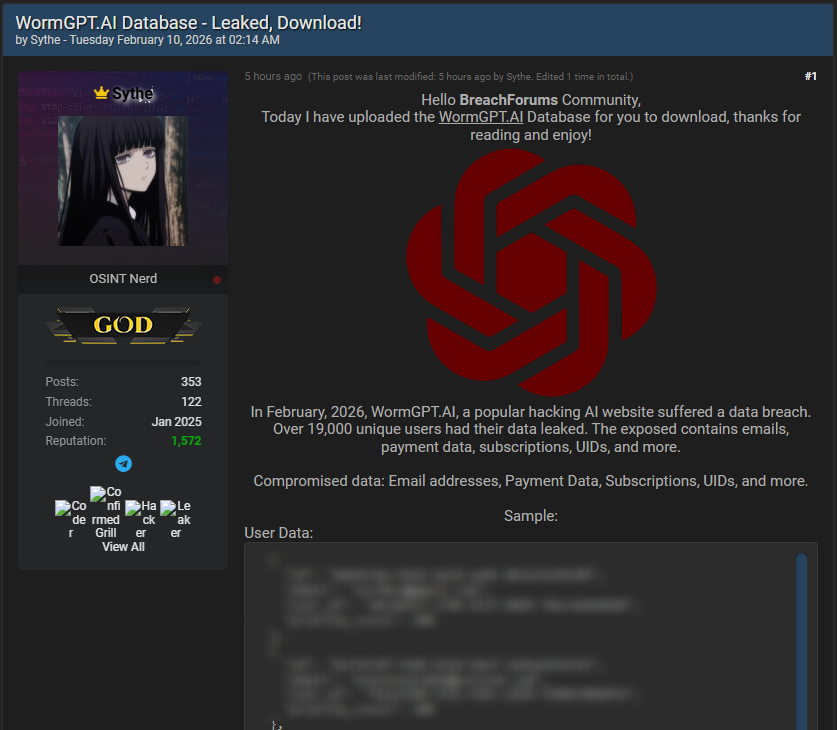
At the time of writing, the claim remains pending verification. The post includes what appears to be a blurred sample view of records and a short description of the data categories, but there has been no direct confirmation from WormGPT operators, and the full dataset is not publicly available through legitimate channels. Readers should treat the listing as unverified until independent validation emerges.
What Was Claimed In The WormGPT Data Breach Listing
The threat actor claimed to have obtained WormGPT’s database and published it for download. The post describes compromised data that includes user email addresses, user IDs, and subscription and billing metadata. The listing also implies that payment-related fields exist in the dataset, but it is not clear whether that refers to partial billing identifiers, payment processor references, plan details, or full payment card data.
That distinction matters. “Payment data” is a phrase frequently used in leak advertising even when the underlying records contain only plan tiers, timestamps, payment status flags, or masked transaction references. If the exposed data is limited to subscription metadata, it still has significant consequences, but it is a different risk profile than exposure of full financial credentials.
The post also attempts to frame the leak as a straightforward “database dump” rather than a limited sample. In many cybercrime ecosystems, the credibility of a leak claim is often signaled by whether the actor provides enough proof for other criminals to validate the data’s structure. In this case, public proof appears limited, which keeps the claim in the pending category.
Background On WormGPT And Why Its User Base Is High Risk
WormGPT has been promoted in underground communities as a “no-guardrails” alternative to mainstream generative AI tools. Unlike consumer-facing AI products that refuse many categories of harmful requests, these illicit tools are marketed as permissive assistants for phishing, social engineering, scam scripting, and other misuse. Even when the actual capabilities are exaggerated, the intended use case is part of the platform’s brand identity.
Because of that positioning, a WormGPT user database is uniquely sensitive. In a typical SaaS breach, leaked emails and subscription details may lead to spam, credential stuffing, or targeted fraud. In a WormGPT-style breach, the leaked user list can become a catalog of individuals who were willing to pay for a tool associated with criminal workflows, which introduces additional exposure risks including extortion, reputational harm, and coercion attempts.
This is also why a WormGPT data breach claim has immediate viral potential. The public interest is not only about another database leak, but about who might be in the database and what the leak implies about user intent. That dynamic can drive misinformation quickly, so careful framing is essential. A leaked email list does not automatically prove identity, intent, or criminal behavior, but criminals often attempt to weaponize the perception anyway.
Scope And Composition Of The Allegedly Exposed Data
Based on the claim’s wording, the dataset allegedly contains at least three categories of information: identifying contact data, internal user identifiers, and billing or subscription metadata. While the exact schema has not been verified, leaks of subscription platforms frequently include several repeatable fields that help attackers map users over time.
If the WormGPT data breach claim is accurate, the leaked dataset may include information such as:
- Email addresses used to register accounts
- User IDs or internal identifiers tied to accounts
- Subscription plan types and pricing tiers
- Subscription start and end timestamps
- Payment status fields such as active, expired, canceled, or refunded
- Basic billing metadata, such as currency, amount, or payment method type
- Transaction references that could be correlated with payment processors
Even if no full financial credentials were exposed, the combination of email addresses and subscription metadata can be used to profile targets. The difference between “user once registered” and “paid for lifetime access” changes the extortion narrative criminals may attempt to build around a victim.
Another practical risk is account takeover. If WormGPT reused login systems common to other underground services, attackers could use the email list for credential stuffing across other sites. Many users in these ecosystems reuse passwords, and many services have weak defenses against repeated login attempts.
Why The WormGPT Data Breach Claim Could Be Real
There are plausible pathways for a breach of an illicit subscription platform. Many of these services are built quickly, hosted in unstable environments, and maintained by operators who prioritize monetization and anonymity over robust security engineering. That combination can produce predictable failures.
Common real-world causes of database exposure include misconfigured cloud storage, exposed admin dashboards, insecure APIs, leaked database credentials, poor access controls, and third-party support tooling that can be abused. Illicit operators also face a unique internal threat problem: competitors, disgruntled insiders, and community disputes are frequent, and “doxing by database leak” is a known retaliation tactic in underground markets.
There is also a business incentive for criminals to leak this type of dataset. If the goal is to harm WormGPT’s operations, exposing the customer list undermines trust. If the goal is profit, the dataset can be resold repeatedly to different buyers who want to identify users for fraud, blackmail, or targeted phishing. In other words, both sabotage and monetization are viable motives.
Why The WormGPT Data Breach Claim Is Also Likely To Be Exaggerated Or Fake
The same factors that make the claim plausible also make the ecosystem saturated with scams. Dark web forums have long been filled with “breach claims” that are stitched together from recycled databases, scraped email lists, or fabricated CSV samples designed to trick buyers into paying for junk.
There are several reasons a WormGPT data breach listing can be misleading even when it contains some real information. One common scenario is repackaging. An actor may take a small set of real records, combine it with unrelated breach data, and label the entire bundle as a WormGPT leak. Another scenario is low-grade scraping, where emails are collected from public channels, contact forms, or invite flows, then presented as a “database.”
A more subtle scenario is that the data is real, but not from a WormGPT backend compromise. It could come from a reseller, an affiliate channel, a payment processor account, or a third-party tool used for customer onboarding. That can still create genuine harm for users, but it changes what “WormGPT data breach” actually means in technical terms.
Finally, high-profile naming can be used as a marketing hook. WormGPT has become a recognizable label in the “criminal AI” narrative. That means scammers can attach the name to almost any dataset and still attract clicks and sales attempts, especially during news cycles where the public is primed to believe the worst.
Risks To Users If The Leak Is Authentic
If the WormGPT data breach claim is authentic, the primary risk is targeted identification. Even when the only exposed field is an email address, attackers can correlate it with breach corpuses, social profiles, prior leaks, domain ownership data, and other sources to map an account to a real-world identity. That is often the first step in coercion campaigns.
Another immediate risk is spearphishing and account hijacking. A tailored phishing message that references a subscription plan, a currency used for payment, or a billing cadence can look convincing because it matches a victim’s actual history. That can lead to compromised email accounts, cryptocurrency theft, or access to other online services.
There is also a reputational threat. Criminals may attempt to message users with threats that imply exposure to employers, family members, or law enforcement, even when the criminal has no proof beyond a leaked email address. These tactics rely on fear, shame, and urgency, not technical leverage. Users should assume that extortion messages, if they begin circulating, may be bluff-based even when the underlying leak is real.
Risks To The Public And The Security Community
A WormGPT user dataset can also fuel downstream cybercrime against unrelated victims. If attackers obtain a list of people who have purchased cybercrime tooling, some will attempt to recruit them, sell them additional tools, or pull them into affiliate programs. That expands the ecosystem.
At the same time, a public leak narrative can trigger a different kind of harm: misinformation and misidentification. People may claim that specific public figures are “in the database” without evidence, or that possession of an email address proves criminal conduct. That is not a safe assumption. Even in underground markets, email reuse, impersonation, burner accounts, and identity layering are common.
For defenders, the incident is still valuable as a signal. If WormGPT’s infrastructure was compromised, it can reveal how these services are built, which can help threat intelligence teams identify infrastructure overlap with other illicit services. That kind of insight can assist in monitoring phishing campaigns that reuse templates or delivery infrastructure generated by such tools.
Plausible Initial Access Vectors
Without verified technical details, the initial access route is unknown. Still, the types of failures that expose subscription databases tend to cluster into a handful of repeatable patterns, especially for small operators running fast-moving services.
- Exposed database ports or weak credentials on internet-facing systems
- Misconfigured cloud buckets containing backups or exports
- Leaked API keys or environment variables in public repositories
- Compromised admin panels or third-party support tooling
- Insider leaks or partner disputes leading to intentional exposure
Backup exposure is a frequent culprit. Many operators create periodic database dumps and store them in predictable locations. If those backups are not encrypted and access-controlled, an attacker may not need to compromise the primary application at all.
Verification Signals That Matter In Claims Like This
Because the WormGPT data breach claim is pending verification, the best approach is to focus on what would actually confirm or weaken the claim. In credible database leaks, independent validators typically look for structural consistency and internal coherence. Do user IDs follow expected formats? Do plan tiers map to pricing seen elsewhere? Do timestamps align with known service activity windows?
Another strong signal is whether the data contains fields that would be difficult to fake at scale, such as internal subscription state transitions, consistent transaction references, or metadata that matches what users have seen inside their own dashboards. Conversely, a “leak” that contains only emails and generic labels with no internal structure often turns out to be a scraped or repackaged list.
For obvious reasons, verification should not involve downloading unknown files from criminal forums. That creates malware risk and legal exposure. The safest validation comes from controlled threat intelligence processes, isolated analysis environments, and careful handling of any materials.
Mitigation Steps For WormGPT Operators And Similar Services
Even illicit operators will often claim they are “secure” to protect revenue. In practice, services like this frequently lack mature security controls. If WormGPT operators intend to survive a leak claim, they would need to demonstrate meaningful containment, even if only to retain their customer base.
- Rotate all secrets, API keys, and database credentials immediately
- Invalidate active sessions and force credential resets
- Audit access logs for backup downloads and abnormal queries
- Identify whether the exposure came from backups, the app, or a third party
- Harden admin access with stronger authentication and IP restrictions
- Remove public access to any storage endpoints and rotate storage tokens
Whether WormGPT would do any of that is another question. But from a purely operational standpoint, these steps are the minimum baseline after a database exposure event.
Recommended Actions For Potentially Affected Individuals
Anyone who believes their email may be associated with WormGPT should focus on practical containment steps that reduce real-world harm, regardless of whether the leak is confirmed. The immediate goal is to prevent account takeover and neutralize phishing attempts that reference the alleged breach.
Botcrawl may earn a commission from purchases made through links in this article.
- Change passwords on any accounts that reused the same credentials
- Enable multi-factor authentication on primary email accounts
- Watch for phishing that references subscriptions, invoices, or “refunds”
- Be cautious of extortion emails that claim “proof” but provide none
- Scan devices for malware and suspicious browser extensions using Malwarebytes
If extortion attempts occur, victims should avoid paying. Payment often escalates targeting, and scammers frequently reuse the same threat script across many recipients. Preserving messages and metadata can help with reporting and filtering, even if the sender is difficult to trace.
Why This Story Matters Beyond WormGPT
The WormGPT data breach claim, whether real or embellished, highlights a broader pattern in the “criminal AI” market. These tools attract customers by promising power without guardrails, but the operational reality is that many are brittle subscription services with low trust and high volatility. A platform that sells criminal capability also creates a concentrated target list, and that list itself becomes a valuable commodity.
This is one of the under-discussed risks of the blackhat AI economy. Even criminals become victims of their own ecosystem. Disputes, opportunistic theft, and doxing are common, and database leaks often function as punishment, not just profit.
For ongoing coverage of major data breaches and broader cybersecurity developments, we will continue publishing verified updates as new technical details emerge.


