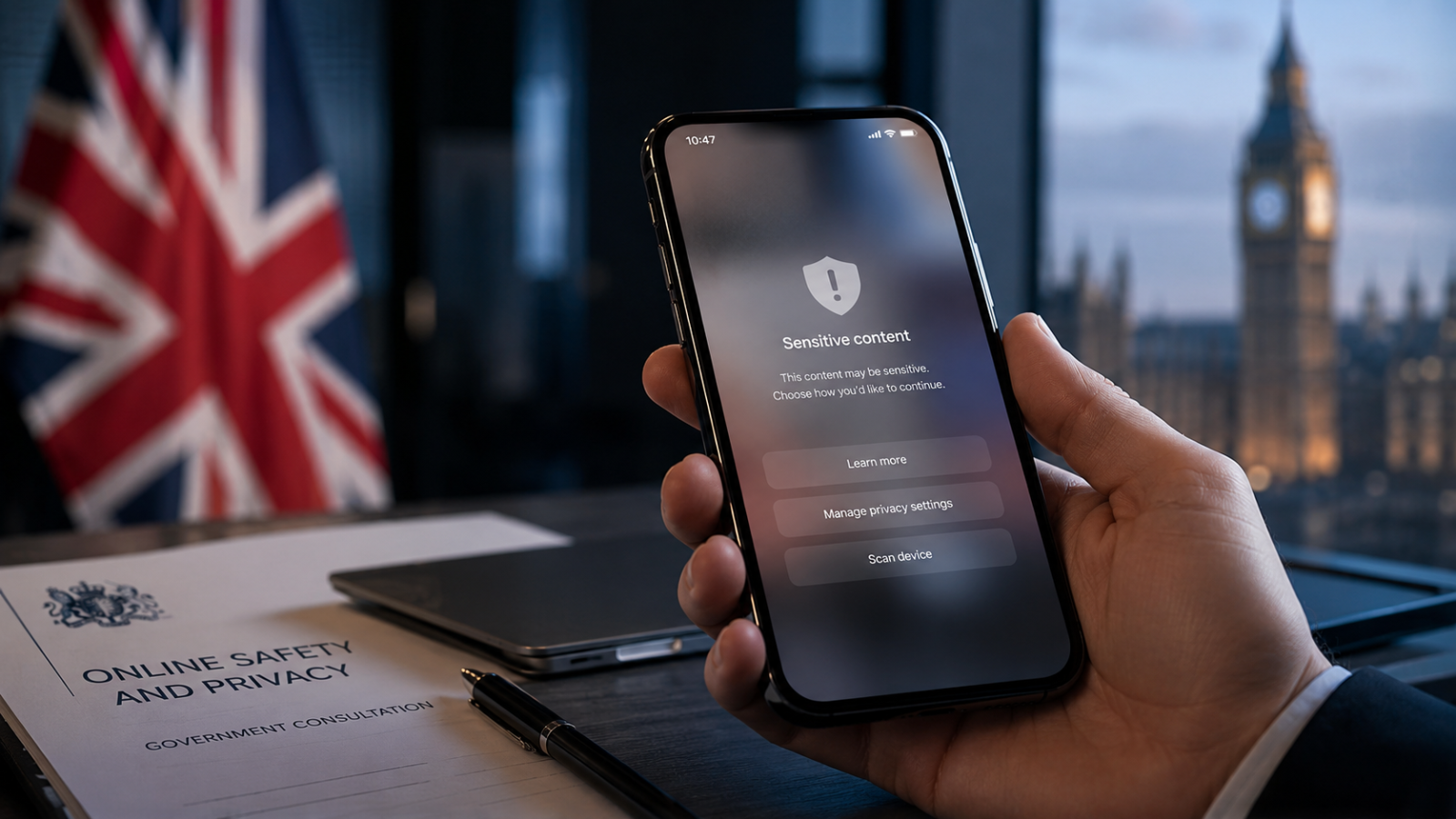

The UK government told companies like Apple and Google in an obscure tweet on Twitter, currently X, that they have three months to activate safeguards on smartphones and tablets that detect and block nude images for children, or face legislation forcing them to do so.
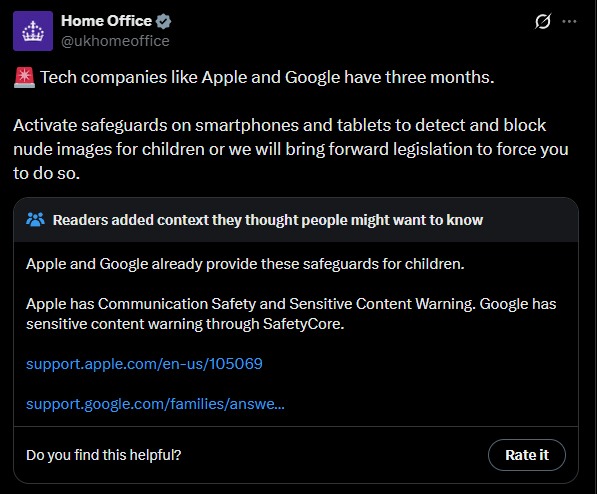
The message was framed as another run-of-the-mill government child-safety ultimatum, stating that tech companies like Apple and Google have three months to activate safeguards on smartphones and tablets to detect and block nude images “for children.” But it was quickly community noted because Apple and Google already provide safeguards for children. The note pointed out that both companies already have on-device features that detect and warn about nudity, including Apple’s Communication Safety and Google’s SafetyCore.
Apple has Communication Safety and Sensitive Content Warning. Google has sensitive content warning through SafetyCore.
That does not mean the safeguards on smartphones and tablets are perfect. They have limits, they do not cover every app in every scenario, and many of them depend on parents setting them up in the first place. Yes, parents, not governments. But instead of acknowledging that these tools already exist and that parents are responsible for using them, the UK government used the same child-safety framing to push the discussion toward device-level blocking, stronger default enforcement, and age verification for adults who want unrestricted use of their own phones and tablets.
That is where the age-verification problem comes in. The proposal does not just pressure companies to protect children. It points toward a system where adults may have to prove their age before using their own phones and tablets without filters. There is no reason to make adults hand over images of their identification or other personal information to the UK government, or to third-party agencies connected to it, just to use devices they already own. This looks less like a missing child-safety feature and more like a government trying to weasel its way into data collection, identity checks, and control over private devices under the usual claim of “protecting children.”
The government’s own framing says adults would still be able to take, share, or view nude content after proving their age. That means the proposal is not only about child accounts. It moves toward a system where adults may need to verify their age before using their own private devices freely.
There is also a security risk in the age-verification process itself. If adults are required to prove their age, someone has to collect, check, process, or store that verification data, and that will likely involve a third party rather than only the government. That can mean identity documents, facial checks, verification providers such as IDMerit, or other sensitive personal information. If that information is breached, leaked, misused, or tied to other accounts, the user carries the risk.
That is the part governments never seem to care about enough. They get to demand the verification system, but ordinary people are left exposed when the data gets stolen or abused. The government does not have to live with the fallout from a leaked ID scan, a breached verification provider, or another database full of personal information being passed around online.
Apple’s existing Communication Safety feature can already detect photos and videos that may contain nudity, blur the content, warn the child, and provide guidance before the child views or sends the material. Apple says the analysis happens on the child’s device, which means Apple does not receive the image or an alert that nudity was detected.
Apple also has Sensitive Content Warning for adults and general users. That feature can detect nude photos or videos before they are viewed, blur the content, and give the user a warning with safety resources. Google’s Sensitive Content Warnings in Google Messages work in a similar direction by detecting and blurring images that may contain nudity, warning users before they receive, send, or forward nude images, and providing safety resources.
So the issue is not whether Apple and Google can build safeguards. They already have. The issue is that the UK government appears to want something stronger than the tools currently available: blocking instead of warning, stronger defaults instead of parental setup, and age checks for adults instead of letting people use their own devices without government-backed restrictions.
The difference between warning and blocking matters. A warning system gives a child, parent, or device setting a chance to respond. A blocking mandate pressures the device maker to inspect content, classify it, decide whether the user is allowed to continue, and enforce the restriction by default. If adults need to verify their age to bypass that restriction, then the device is no longer simply working for the owner. It is enforcing a government-backed control layer.
On-device scanning is often described as privacy-preserving because the image does not have to leave the phone. That can be true when the feature is optional, limited, transparent, and controlled by the user or parent. It becomes a different issue when scanning is pushed by government demand, made default, tied to legal threats, and connected to adult age verification.
A device can still inspect private content even if the image never leaves the device. The owner can still lose control over what the phone allows, blocks, warns about, or requires verification to access. The privacy debate should not stop at whether Apple or Google receives a copy of the image. The larger issue is whether a privately owned device is being forced to classify and restrict legal content because the government demanded it.
This is why the “protect children” argument needs to be challenged when it is used too broadly. Child safety is important, but it should not become a blank check for device scanning, digital ID systems, age checks, or content controls that affect adults too. Governments have a habit of identifying a real problem involving minors, demanding broad technical controls, and then acting as if anyone who questions the system is against protecting children.
Parents already have tools available. Apple has Communication Safety. Google has SafetyCore. Device makers can improve these features, and parents can decide how to manage their own children’s devices. What the government should not do is use children as the political shortcut for broader device scanning and adult age verification.
Adults should not have to prove their age to a company, verification provider, or government-backed system just to use their own smartphones and tablets without nudity filters. The UK government’s tweet made the demand sound simple, but the reality is much broader. Apple and Google already have safeguards, and the government is now pushing toward wider blocking, stronger default enforcement, and age verification for adults.
That is not just a child-safety proposal. It is a fight over who controls private devices, who gets to inspect content on them, and whether adults should have to hand over personal information before using their own phones without government-backed restrictions.
- Google Health Shows Where Big Tech Wants Wellness to Go
- Foldable iPhone Design and Release Details Leak Online
- Kimwolf Android Botnet Exploits Residential Proxies to Breach Internal Networks
- DroidLock Malware Locks Android Phones and Demands Ransom
- iOS 26 Zero Day Exploit Listed for Sale on Dark Web

Related Posts