

The Nissan data breach is a confirmed cybersecurity incident involving Nissan Motor Co., Ltd. following unauthorized access to servers operated by its business partner Red Hat. The incident resulted in the exposure of personal information belonging to approximately 21,000 customers associated with Nissan Fukuoka Sales Co., Ltd. Nissan publicly disclosed the breach in December 2025 after completing an internal review and notifying regulators.
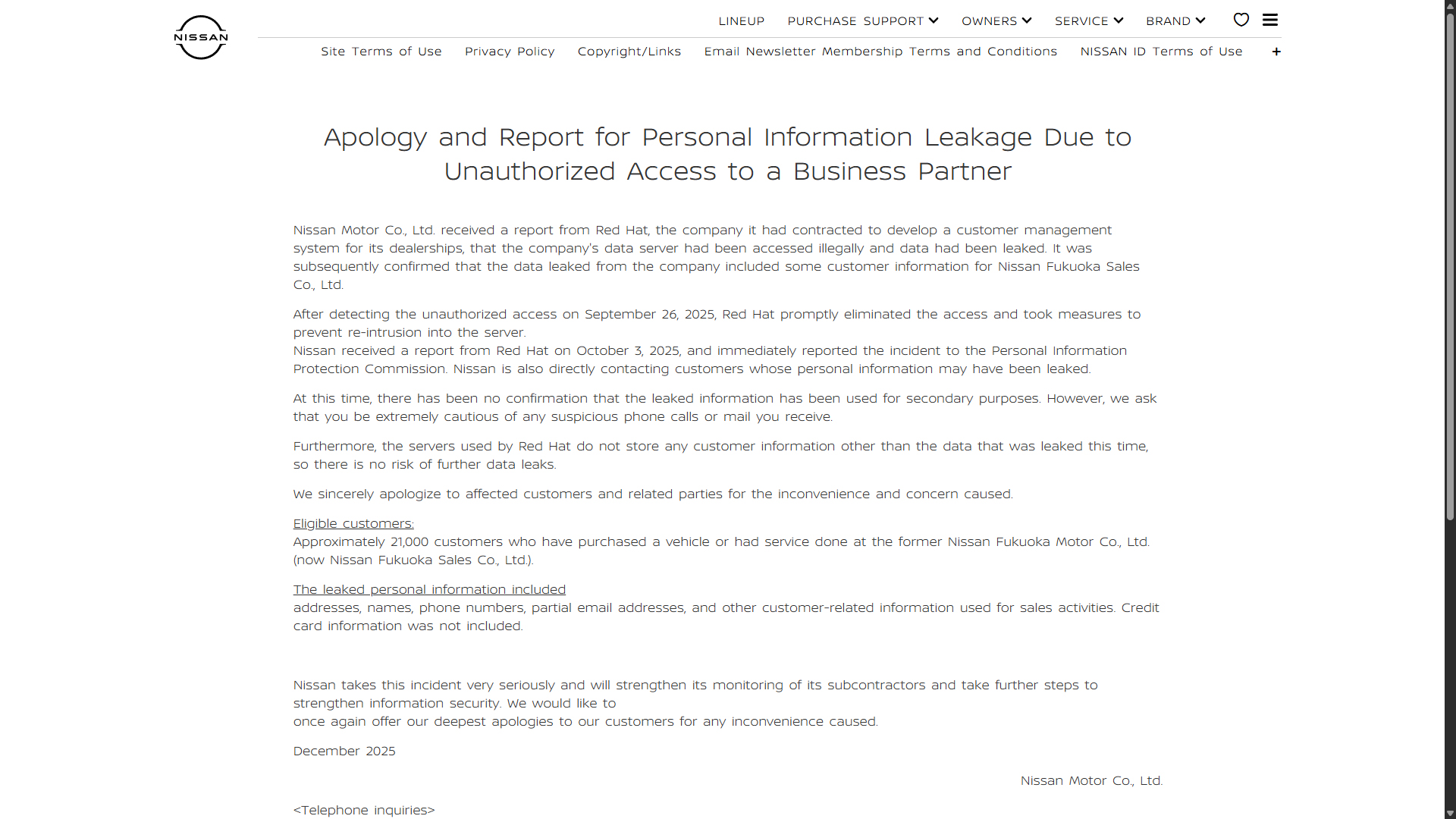
According to Nissan’s disclosure, the intrusion was detected on September 26, 2025, when Red Hat identified unauthorized access to a data server used to support dealership customer management systems. Nissan was formally notified on October 3, 2025, after Red Hat confirmed that customer data had been accessed and leaked. The breach highlights the growing systemic risk posed by third party vendors that manage sensitive customer information on behalf of large enterprises.
The Nissan data breach is particularly significant because it demonstrates how indirect compromises can affect consumer trust even when the primary organization’s internal systems are not directly penetrated. For customers, the distinction between a contractor and the brand itself is largely irrelevant when personal data is exposed.
Background on Nissan Motor Co., Ltd.
Nissan Motor Co., Ltd. is one of the world’s largest automotive manufacturers, with global operations spanning vehicle design, manufacturing, sales, and after sales services. In Japan, Nissan operates an extensive dealership network that handles vehicle purchases, maintenance, warranty services, and customer relationship management for millions of drivers.
To support these activities, Nissan relies on a complex digital ecosystem that includes internal systems and externally developed platforms used by regional dealerships. These systems routinely process customer names, addresses, contact details, and service histories to support sales operations and customer engagement.
As with many multinational manufacturers, Nissan outsources portions of its IT development and system management to specialized technology partners. While this approach offers scalability and efficiency, it also introduces third party risk when vendors maintain access to sensitive data environments.
Timeline of the Nissan Data Breach
The sequence of events surrounding the Nissan data breach provides insight into how third party incidents unfold and are disclosed.
Red Hat detected unauthorized access to its server environment on September 26, 2025. Upon discovery, the company immediately blocked the intrusion and implemented measures to prevent further access. Subsequent investigation confirmed that customer data associated with Nissan Fukuoka Sales Co., Ltd. had been exposed.
Nissan was notified of the incident on October 3, 2025. Following receipt of the report, Nissan initiated its internal response procedures, reported the incident to Japan’s Personal Information Protection Commission, and began assessing the scope of affected customers.
Public disclosure was made in December 2025 after Nissan confirmed the nature of the leaked data and completed initial regulatory coordination. Nissan also began directly contacting customers whose personal information may have been affected.
Scope and Composition of the Exposed Data
The Nissan data breach involved personal information used for dealership sales and service activities. Nissan confirmed that approximately 21,000 customers of the former Nissan Fukuoka Motor Co., Ltd., now operating as Nissan Fukuoka Sales Co., Ltd., were affected.
The leaked information included:
- Customer names
- Residential addresses
- Phone numbers
- Partial email address information
- Customer records used for sales related activities
Nissan confirmed that credit card information and payment data were not included in the exposed dataset. While the absence of financial data reduces immediate fraud risk, the exposure of contact and address information still presents meaningful security and privacy concerns for affected individuals.
Even partial email address exposure can be sufficient to enable targeted phishing attacks when combined with names and physical addresses. This type of dataset is often leveraged for social engineering rather than direct financial theft.
Impact on Affected Customers
The Nissan data breach creates several potential risks for affected customers, particularly those who have interacted with Nissan dealerships for purchases or service.
Key risks include:
- Targeted phishing attempts impersonating Nissan or dealership staff
- Fraudulent phone calls referencing vehicle ownership or service history
- Direct mail scams using accurate name and address information
- Increased exposure to identity based social engineering
Nissan stated that, as of its disclosure, there had been no confirmation that the leaked information was used for secondary malicious purposes. However, data leaks of this nature often result in delayed misuse, as exposed records circulate through underground markets over time.
Customers are advised to treat any unsolicited communication referencing Nissan ownership or service activity with heightened caution.
Third Party Vendor Risk and Systemic Exposure
A critical aspect of the Nissan data breach is its origin within a contractor managed environment. The affected server was operated by Red Hat, which had been contracted to develop and manage a customer management system for Nissan dealerships.
This incident underscores a recurring pattern in large scale data breaches, where attackers target vendors that hold valuable data but may not be as closely monitored as core enterprise systems. Once access is gained, attackers can extract data tied to multiple downstream organizations.
Third party risk is particularly acute in industries such as automotive manufacturing, where customer data flows across dealerships, service providers, software vendors, and cloud platforms. Each additional integration expands the potential attack surface.
Threat Actor Activity and Attack Characteristics
Nissan did not publicly attribute the breach to a specific threat actor group, and no ransom demand or extortion activity was disclosed. The intrusion appears to have involved unauthorized server access rather than disruptive malware deployment.
In similar incidents involving vendor hosted systems, attackers often exploit misconfigurations, stolen credentials, or unpatched vulnerabilities to gain access. Once inside, data is extracted quietly to avoid detection before access is terminated.
The absence of confirmed secondary misuse does not diminish the seriousness of the incident. Data exposure alone represents a breach of trust and can have long term consequences even if immediate harm is not observed.
Regulatory Response and Disclosure Obligations
Following notification from Red Hat, Nissan reported the incident to the Personal Information Protection Commission in Japan, fulfilling its regulatory obligation under national data protection laws. Nissan also initiated direct communication with affected customers to inform them of the breach and provide guidance.
As a major manufacturer operating in regulated markets, Nissan is subject to strict expectations regarding data protection governance and vendor oversight. Incidents involving personal information can lead to regulatory scrutiny, internal audits, and mandated improvements to security controls.
Nissan publicly acknowledged responsibility for the incident and issued an apology to affected customers and related parties, emphasizing its commitment to strengthening information security practices.
Mitigation Actions Taken by Nissan and Red Hat
According to Nissan’s disclosure, Red Hat eliminated the unauthorized access promptly after detection and implemented measures to prevent re intrusion into the affected server environment. Nissan confirmed that the server did not store additional customer information beyond the data already leaked, reducing the risk of further exposure.
Nissan stated that it is strengthening monitoring of subcontractors and enhancing oversight of partner managed systems. These measures typically include stricter access controls, improved logging, regular security assessments, and contractual security requirements for vendors.
While these steps are necessary, incidents like the Nissan data breach demonstrate that preventative controls must be continuously evaluated rather than assumed effective based on prior assurances.
Recommended Actions for Affected Individuals
Customers who believe they may be affected by the Nissan data breach should take practical steps to reduce risk.
Recommended actions include:
- Remain alert for suspicious phone calls or emails referencing Nissan or vehicle services
- Avoid sharing personal or account information in response to unsolicited contact
- Verify communications by contacting dealerships directly through official channels
- Monitor for signs of identity misuse or unusual correspondence
- Scan personal devices for malware using Malwarebytes
These precautions are particularly important in the months following a breach, when exposed data is most likely to be exploited.
Broader Implications for the Automotive Industry
The Nissan data breach reflects a broader challenge facing the automotive industry as vehicles, dealerships, and customer engagement systems become increasingly digital. Manufacturers are no longer solely responsible for protecting internal systems but must also manage the security posture of a complex network of partners.
Customer trust is closely tied to brand reputation, and breaches involving personal data can undermine confidence even when the root cause lies with a contractor. As attackers continue to target supply chains and service providers, automotive companies must treat third party security as an extension of their own risk management strategy.
The incident serves as a reminder that cybersecurity in manufacturing is no longer limited to production lines and intellectual property. Customer data protection is now a central component of operational resilience.
For continued coverage of confirmed data breaches and deeper analysis across the cybersecurity landscape, we will continue to publish verified reporting and authoritative insights.

Related Posts

ServiceNow Data Breach Exposes Customer Tenants to Unrestricted API Access
The ServiceNow data breach claim involves suspicious customer tenant activity tied to a possible unrestricted API access issue in ServiceNow environments. The data breach…
Read article
GitHub Data Breach Confirmed After Poisoned VS Code Extension Exfiltrates Internal Repositories
GitHub has confirmed a data breach involving unauthorized access to internal repositories after an employee device was compromised through a poisoned Visual Studio Code…
Read article
Vodafone Data Breach Claim Follows LAPSUS$ Data Leak
Claims of a Vodafone data breach are circulating after LAPSUS$ said it published data tied to the telecommunications company following failed negotiations. The group’s…
Read article