

Watchdog PC Cleaner is promoted as a professional grade PC cleaning tool with a quick scan and clean process that will make sure your PC is back to its best possible performance point. However, according to VirusTotal, Watchdog PC Cleaner has a poor community score is detected by security programs as a potentially unwanted program (PUP).

DrWeb detects the WatchdogPCCLeaner2018Setup file as Program.Unwanted.2485, Malwarebytes detects the same file as PUP.Optional.WatchDogPCCleaner and ESET-NOD32 detects the same file as a variant of MSIL/PCCleaningUtility.C potentially unwanted.
Why the Watchdog PC Cleaner program is detected as a potentially unwanted program can vary. For one, Microsoft does not support computer cleaning programs and registry cleaners like Watchdog PC Cleaner because they can cause errors and harm your system. Furthermore, Watchdog PC Cleaner itself is only a free trial and in order to use the program, you will need to pay to register the program. Most people may not be aware that the program is not free to use; the program does not say it is a trial, the icon does not say it’s a trial, and there are no further indications that it is a trial until after a scan is performed and results are shown. This is a frowned upon marketing practice and technique that is employed by many similar programs and most of the programs are detected as potentially unwanted programs or malware.
The instructions below will help you removePUP.Optional.WatchDogPCCleaner and other unwanted and malicious files from your computer:
1. Download Malwarebytes Anti-Malware software to scan your computer and remove malicious files and potentially unwanted programs.
2. To install the program, locate and double-click the executable file you just downloaded. The file can usually be found in the Download folder.
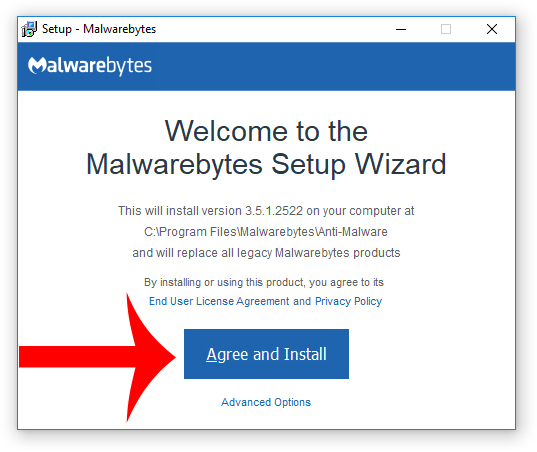
3. Choose if this is for home or work use and click Agree and Install to begin installing Malwarebytes. Once the installation is complete, click Finish.

4. Once Malwarebytes is installed, open the program and click the Scan Now button on the dashboard – or go to the Scan tab and click the Start Scan button.

5. When the scan is complete click the Quarantine Selected button.
6. If Malwarebytes says “All selected items have been removed successfully. A log file has been saved to the logs folder. Your computer needs to be restarted to complete the removal process. Would you like to restart now?” click the Yes button to restart your computer.
7. Download HitmanPro to perform a second-opinion scan and remove any remaining malicious trace files. A second-opinion scan is important when removing malware and malicious files from your computer.
8. To install the program, locate and double-click the executable file you just downloaded. The file can usually be found in the Download folder.
9. Once HitmanPro is installed, open the program and click Next to start scanning your computer. *If you are using the free version you may choose to create a copy or perform a one-time scan.
10. When the HitmanPro scan is complete, click the Next button.
11. To activate the free version of HitmanPro: enter your email address twice and click the Activate button.
12. Click the Reboot button.

Related Posts

Cloudflare Says Anthropic Mythos Can Chain Bugs Into Working Exploits
Cloudflare says Anthropic’s Mythos Preview can move beyond finding isolated software bugs and combine smaller vulnerabilities into working exploit chains, a shift that changes…
Read article
DigiCert Revokes 60 Code Signing Certificates After Support Malware Incident
DigiCert revoked 60 code signing certificates after a malware incident involving its customer support team gave an attacker access to initialization codes for pending…
Read article
ClickUp Data Leak Shows $4B Came Before Customer Security for Over a Year
A researcher known as Impulsive says ClickUp exposed customer emails, internal feature flags, and sensitive configuration data through a public-facing setup anyone could reach…
Read article